
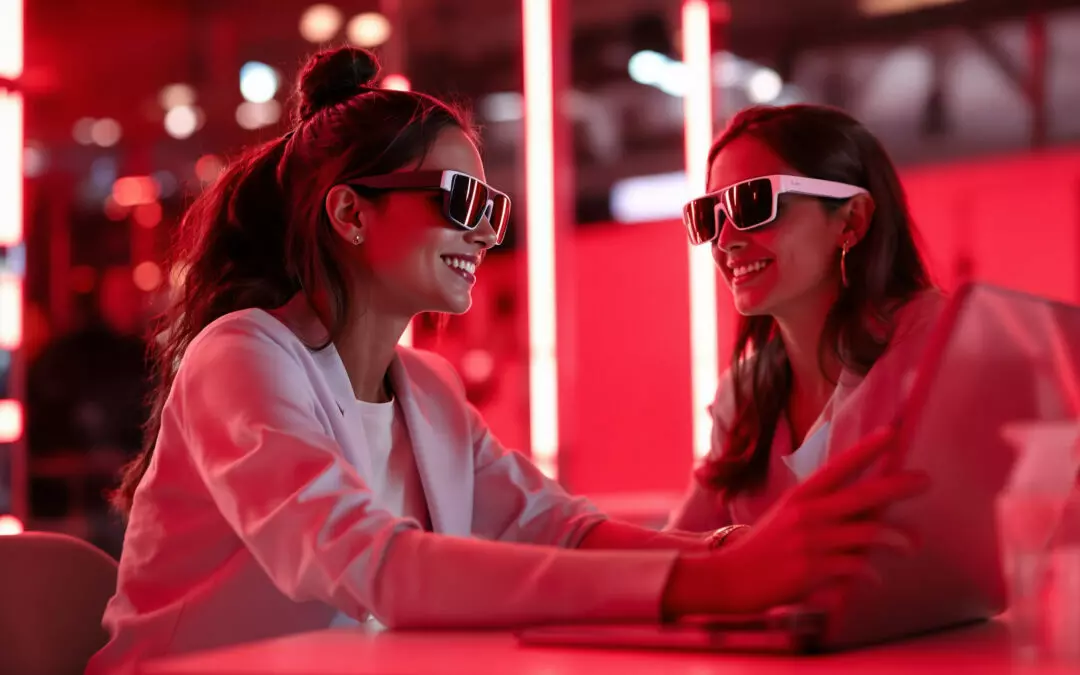
Ray-Ban glasses Meta are perfect for creating immersive POV content, behind-the-scenes footage, and short-form videos without taking out your smartphone. Their strength: capturing moments from eye level, with 3K Ultra HD video on Gen 2 launched in 2025, open-ear audio, Meta AI, and Instagram/Facebook livestreaming. Here are 15 concrete ideas, designed for Instagram, TikTok, YouTube Shorts, Facebook, and LinkedIn.
Why Ray-Ban Meta glasses are changing social content
Since 2015, I’ve watched Snapchat Stories, Instagram Lives, Reels, TikTok, Shorts, and then the massive return of raw content. Ray-Ban Meta glasses fit that logic perfectly: less heavy staging, more direct point of view.
The first-generation Ray-Ban Meta, introduced in 2023 as the successor to Ray-Ban Stories, added Meta AI, better camera/audio performance, and livestreaming to Instagram and Facebook. The Gen 2 announced in September 2025 goes further with 3K Ultra HD video at up to 60 fps, ultrawide HDR, battery life of up to 8 hours in typical use, and a case that can add up to 48 hours.
In practice, the appeal is not just technical. It’s the visual language. A smartphone often films like an outside observer; glasses film like someone living the scene. For a creator in food, sports, travel, retail, beauty, or events, that shift in perspective can be enough to improve retention in the first three seconds.
If you’re already following the evolution of Meta x Ray-Ban smart glasses, you know this topic goes beyond a gadget. It’s a new social production tool, as long as you use it with a real content grammar.
15 content ideas with Ray-Ban Meta glasses
The classic trap is filming anything and everything in POV. Bad idea. The format works when viewers immediately understand where they are, what they’re looking at, and why they’re staying.
- POV event arrival : entering a trade show, backstage, red carpet, pop-up store. Keep the first 2 seconds very clear.
- Unboxing hands-free : opening a package, handling the product, showing the details without a tripod. Ideal for Reels and TikTok.
- Creator routine : lighting setup, mic, background, script. Followers love seeing behind the scenes.
- Product test in real conditions : running, cooking, makeup, urban cycling, retail visit. POV adds credibility to the use case.
- Mini vlog “an hour with me” : quick edit, not a long journal. Three strong scenes are enough.
- Influencer campaign behind the scenes : briefing, filming, approval, publishing. Excellent for LinkedIn from the advertiser's perspective.
- Recipe or food prep : keeping the camera at eye level makes the steps easier to follow.
- Shopping guided : selecting items, trying them on, comparing prices. In this niche, it's better to comment voice-over style rather than speak in the store.
- Sports event POV : arrival, stands, atmosphere, reaction. Watch out for music rights and venue rules.
- Trade tutorial : hairstylist, barista, photographer, craftsman, coach. The viewer sees exactly what you see.
- Before/after on site : layout, storefront, set design, shoot. Very effective in a cut edit.
- Instagram or Facebook Live : a useful format for guided tours, demonstrations, or Q&A.
- Spontaneous micro-interviews : two questions max, steady framing, clear consent.
- “Decision live” story : choosing an outfit, a photo spot, a product. The format encourages story polls.
- Quick audit of a location : restaurant, store, booth, gym. For local brands, it’s very readable.
Honestly, the format only works if you’re willing to shoot tight. A three-minute recording can produce five to eight short clips, but rarely a raw video that’s publishable as-is.
Which format should you publish on Instagram, TikTok, YouTube, and LinkedIn
Each platform reads POV differently. On TikTok, the visual hook has to be immediate. On Instagram, aesthetics and social context matter more. On YouTube Shorts, the promise needs to be very clear, almost documentary-style.
LinkedIn deserves its own approach. POV works there less to “look cool” than to prove a process: manufacturing, factory tour, event behind the scenes, sales team day. Advertisers can use it as on-the-ground proof in a broader B2B content strategy, especially in connection with a logic of measurable influencer marketing in 2026.
| Platform | Recommended use with Ray-Ban Meta glasses | Target duration | Key consideration |
|---|---|---|---|
| Instagram Reels | Lifestyle POV, event, unboxing, shopping | 15 to 45 s | Polish the cover and the first 2 seconds |
| TikTok | Real test, routine, mini storytime, reaction | 10 to 35 s | On-screen text is essential if the audio is muted |
| YouTube Shorts | Tutorial, comparison, guided tour | 20 to 60 s | Clear promise from the very first sentence |
| Instagram/Facebook Live | Product demo, trade show, launch, behind the scenes | 10 to 30 min depending on audience | Warn the audience before going live |
| B2B behind the scenes, manufacturing, professional event | 30 to 90 sec | Add a business angle, not just an immersive one |
One useful clarification: the v6.0 software update, reported in 2024 by several tech media outlets, extended Ray-Ban Meta video recording up to 3 minutes. That is not an invitation to post three uninterrupted minutes. It is rather a comfortable margin to capture a complete scene before extracting the best part.
Editorial settings that really make a difference
POV is less forgiving than people think. A head movement that is too quick makes for a tiring video, especially on mobile. Before filming, practice slowing down your gestures: look, pause briefly, then change angle.
With 3K Ultra HD video, ultrawide HDR, and the Wayfarer, Skyler, and Headliner styles of Gen 2, the technical quality already allows a lot. But the algorithm does not reward the product sheet. It rewards retention, shares, saves, and relevant comments.
A good workflow has four steps: short capture, strict selection, vertical editing, native publishing. Avoid recycling exactly the same version everywhere. A TikTok can handle very direct text; a Reel will often perform better with a more visual intro; a Short should state the benefit more clearly.
For creators following Meta's AI developments, also keep an eye on adjacent uses such as the Meta AI pendant focused on voice capture or announcements around Ray-Ban glasses designed for wearers of corrective lenses. Content production uses are getting closer: voice, image, context, assistant.
Pitfalls to avoid before filming with Ray-Ban Meta glasses
First pitfall: forgetting consent. Connected glasses seem more discreet than a smartphone, so they may be more unsettling. At events, in stores, or during interviews, announce the recording and avoid identifiable third-party faces if you do not have permission.
Second pitfall: confusing immersion with surveillance. Rumors about codes linked to facial recognition in the Meta AI app, reported in 2026 by tech media, do not correspond to a confirmed and released Ray-Ban Meta feature. Precisely for that reason, set an example: transparency, respectful framing, intentional use.
Third pitfall: neglecting the sound. The glasses offer open audio and Meta AI voice assistant features, but a noisy environment is still a noisy environment. For sponsored content, plan on a clean voice-over in post-production.
Finally, do not overestimate the "novelty" aspect. In 2026, competition is intensifying with Google, Snapchat, Xiaomi, Rokid, and even cheaper Meta AI glasses announced at $299 according to several tech media outlets. To understand this battle, the analysis on the connected glasses between tech giants and opticians gives a good strategic perspective.
How to integrate this content into an influencer campaign
For a brand, Ray-Ban Meta glasses should not be just a visible accessory on screen. They need to justify an angle: “I’m taking you with me,” “I’m testing this like a customer,” “I’m showing you what no one sees.” That’s when the setup becomes useful.
An effective brief specifies three things: the scenes to capture, the limits to respect, and the deliverables expected by platform. For example, ask for a 30-second Reel, three stories, one Short, and five raw clips usable in paid social. That’s clearer than a vague request for “immersive content.”
As for compensation, rates will always depend on the niche, the audience, usage rights, and the production level. The right approach is to value organic posting, raw clips, sector exclusivity, and advertising use separately. Many advertisers forget this, and that’s where creators lose value.
For a retail, tourism, or sports campaign, I would recommend pairing one lead creator with two local micro-creators. The first brings reach, the second brings more authentic angles. To go further on emerging uses, the topic of microcultures on social media helps build less generic activations.
ValueYourNetwork supports creators, influencers, community managers, and brands in their social media strategies, from creative idea to the rollout of high-performing campaigns; whether you are an influencer or an advertiser, contact us to grow your social media with us.
FAQ on Ray-Ban Meta glasses and content creation
What videos should you create first with Ray-Ban Meta glasses?
Start with three simple formats: an arrival POV at a location, a product test in real-world conditions, and a behind-the-scenes routine. These are the formats the audience can understand most easily.
Are Ray-Ban Meta glasses suitable for sponsored content?
Yes, especially for event, retail, sports, food, travel, and lifestyle campaigns. However, you need to plan a precise brief, consent rules, and an edited version for each platform.
Can you go live with Ray-Ban Meta glasses?
The Ray-Ban Meta launched in 2023 introduced livestreaming to Instagram and Facebook. Live works well for a guided tour or a demo, provided you announce the event ahead of time and keep a clear narrative thread.
What is the ideal length of a video shot with Ray-Ban Meta glasses?
Even though recording can go up to 3 minutes since the v6.0 update reported in 2024, the best social clips often fall between 10 and 45 seconds. Editing remains crucial.