
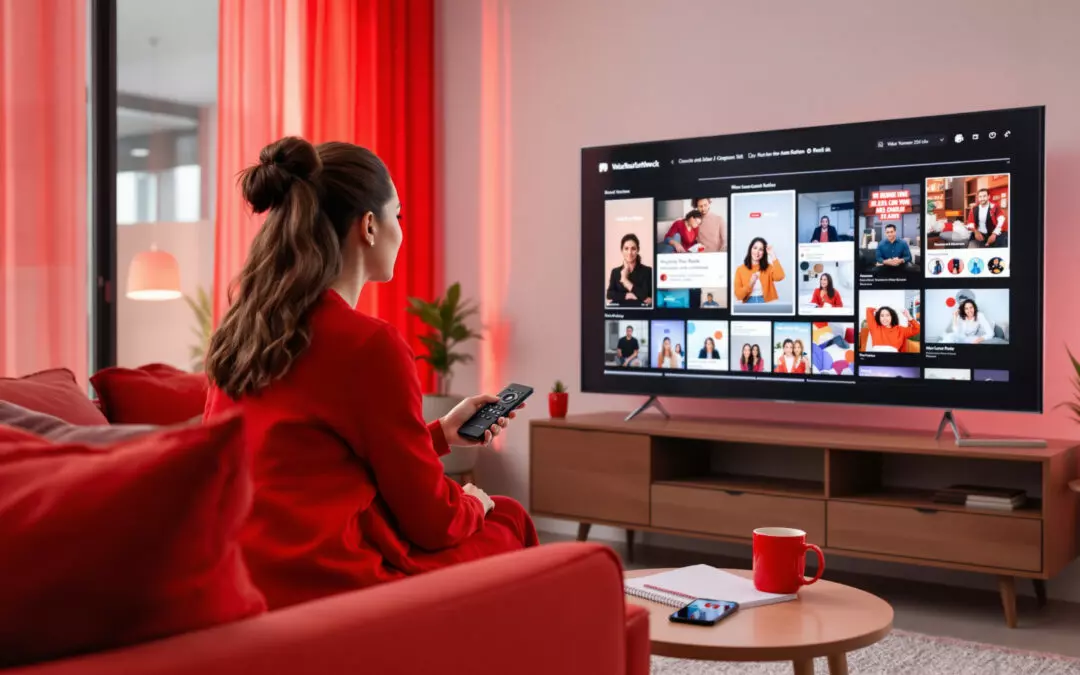
Instagram on Samsung Smart TV turns the Reels feed into a living-room experience: fewer comments, more passive viewing, and attention captured on the big screen. For creators and brands, this is not a gimmick. It forces us to think about videos that are readable from ten feet away, with branding that stays visible without overpowering the format.
Instagram on Samsung Smart TV: what really changes
Samsung and Meta are pushing Instagram onto connected TVs, continuing a use case already well established on YouTube, TikTok, and Twitch. The idea is simple: make it possible to view Instagram content on certain Samsung Smart TV models, with navigation designed for the remote control and the comfort of the couch.
The most interesting change is not technical. It is behavioral. On mobile, users comment, reply in DMs, tap a sticker, and save. On TV, they watch more than they interact. It’s a mode similar to binge-watching, as we already see with the passive scrolling among Gen Z.
A familiar pattern: since 2015, every time a social network lands on a larger screen, the winning content changes. Videos with too much text lose impact. Narrative formats, on the other hand, breathe more easily.
Why endless scroll is coming to TV now
Platforms want to capture minutes of attention wherever they are available. The living room remains a powerful space: YouTube has already built part of its growth there, especially through TV apps and Shorts that can be viewed on the big screen. Instagram is following this trend, with Reels as the natural format.
Samsung has a clear advantage: its installed base of connected TVs and its app ecosystem. Meta, for its part, is looking to extend the time spent on Instagram beyond mobile. It’s no coincidence that social interfaces are increasingly borrowing from premium video conventions.
Honestly, this format only works if the content stands on its own without the mobile context. A Reel built around a tiny line of text at the top of the screen, a pinned comment, or a highly coded audio trend can become unreadable on TV. By contrast, a tutorial, a recipe, a before-and-after beauty clip, or a sports highlight works very well.
| Platform on connected TV | Dominant format | Common usage observed | Creator focus point |
|---|---|---|---|
| YouTube TV, widely rolled out since the 2010s | Long-form videos, Shorts | Extended viewing, active search | Thumbnail, pacing, and chaptering |
| TikTok TV, launched in several markets as early as 2021 | Vertical videos in a feed | Passive consumption of trends | Text readability and vertical framing |
| Instagram on Samsung Smart TV | Reels, visual content | Discovery from the couch | Visible branding, immediate storytelling |
| Twitch on Smart TV | Long-form live content | Community viewing | Limited interaction without a second screen |
Creators: adapt your Reels for the big screen
A Reel designed for Instagram on Samsung Smart TV has to remain understandable without touchscreen support. The field rule: if your video is clear when you watch it from three meters away for five seconds, it has a chance. Otherwise, it will get skipped.
Focus mainly on the foreground. An expressive face, a product gesture, a final result shown from the start: this is more effective than a long-winded intro. In this niche, it is better to have an edit that is less frantic but more readable, especially for beauty, food, fitness, home decor, and automotive.
- Place subtitles in the lower center, large enough, without covering the product.
- Avoid tiny text in the corners, which is often invisible on TV.
- Keep a logo or brand element discreet but present within the first three seconds.
- Shoot in clean 9:16, but make sure the main subject remains readable on a widescreen display.
- Plan a version that does not rely on comments, since TV interaction remains limited.
Creators who already know how to engage niche communities will have a head start. Social microcultures, analyzed in our reading of microcultures on social media, are especially compatible with living room viewing when they tell a strong visual story.
Advertisers: what TV changes in an Instagram campaign
For a brand, Instagram on Samsung Smart TV brings paid social closer to a CTV reflex, without becoming traditional TV advertising. Attention is more comfortable, but immediate action drops. No one fills out a complex form with a remote control.
The right approach is to treat this channel as a memory amplifier. A product launch, a usage demo, highly authentic creator content: yes. A direct conversion mechanism with a tiny promo code: less relevant. The campaigns that perform best often combine the big screen for exposure and mobile for the click.
The rookie mistake is to reuse a Stories creative without review. In 2024, Instagram CPMs vary widely depending on country, targeting, and season, often ranging from a few euros to more than €15 in competitive verticals. On connected TV, the perceived value can be higher, but only if the creative deserves the screen.
To structure your trade-offs, connect this shift to the measurement challenges discussed in our analysis of efficiency-focused influencer marketing. The question is no longer reach alone. It’s the exact role of the content in the journey: discovery, consideration, reassurance, or purchase.
Algorithm, attention, and the second screen: the real issue
Instagram is still driven by interest signals: watch time, repeat views, shares, saves, interactions. On TV, some signals change in weight because the user acts less. Watch time becomes even more strategic.
Content watched to the end on a big screen can still help reveal preference patterns, even if the user doesn’t like it. This logic echoes Instagram’s recent adjustments around feed control, a topic ValueYourNetwork covered with the arrival of the button to control your Instagram algorithm.
The second screen will matter. A viewer can watch a Reel on TV, then look up the creator on mobile, send the content to a friend, or buy later. This back-and-forth between the TV and mobile also multiplies touchpoints and connections, often on shared home networks: remind your audience of a few online safety tips before clicking, logging in, or completing a purchase spotted from the living room. Measuring only the immediate click therefore amounts to underestimating the impact. It’s frustrating, but that’s the reality of social usage since the massive rise of short-form formats.
Brands testing this territory need to isolate their variables: same creator, same message, two creative versions, one designed for mobile and one for TV. After two to four weeks, compare completion rate, brand searches, direct traffic, and social signals. Not just likes.
The action plan for testing without wasting your budget
Start small. Select three to five pieces of content that are already strong on mobile, then rework them for TV viewing: larger text, a slower pace, a clearer product shot. A test campaign doesn’t need twenty variations if the creative diagnosis is solid.
On the influencer side, prioritize profiles that can tell a story visually. A food creator showing a texture, a fitness coach correcting a movement, a decorator transforming a room: this content gains value on a television screen. Conversely, videos that rely heavily on a trending sound age quickly.
Also look at what YouTube is doing on connected TV. Advances around YouTube AI and connected TV point to a clear direction: video discovery is going to become more assisted, more personalized, and probably harder to attribute cleanly.
ValueYourNetwork supports creators and brands with social formats, influencer campaigns, and multi-platform strategies; whether you are an influencer or an advertiser, grow your social networks with us and contact us to build a tailored approach.
FAQ about Instagram on Samsung Smart TV
Is Instagram on Samsung Smart TV available for all models?
Availability depends on model, country, and Samsung software updates. Check your TV’s app store and the official Samsung or Meta announcements for your market.
Can you post Reels from a Samsung Smart TV?
TV usage is mainly for viewing. For publishing, editing, replying to messages, or managing a campaign, mobile and desktop remain the most suitable environments.
Which Instagram content works best on connected TV?
Visual, narrative, and easy-to-read content that requires no interaction performs best: tutorials, recipes, sports, beauty, home decor, travel, product reviews. Videos based on short text snippets or comments often lose effectiveness.
Can Instagram on TV improve the results of an influencer campaign?
Yes, especially for awareness and memorability. For conversion, plan a clear mobile follow-up: link in bio, simple code, retargeting, and complementary content tailored to the click.