
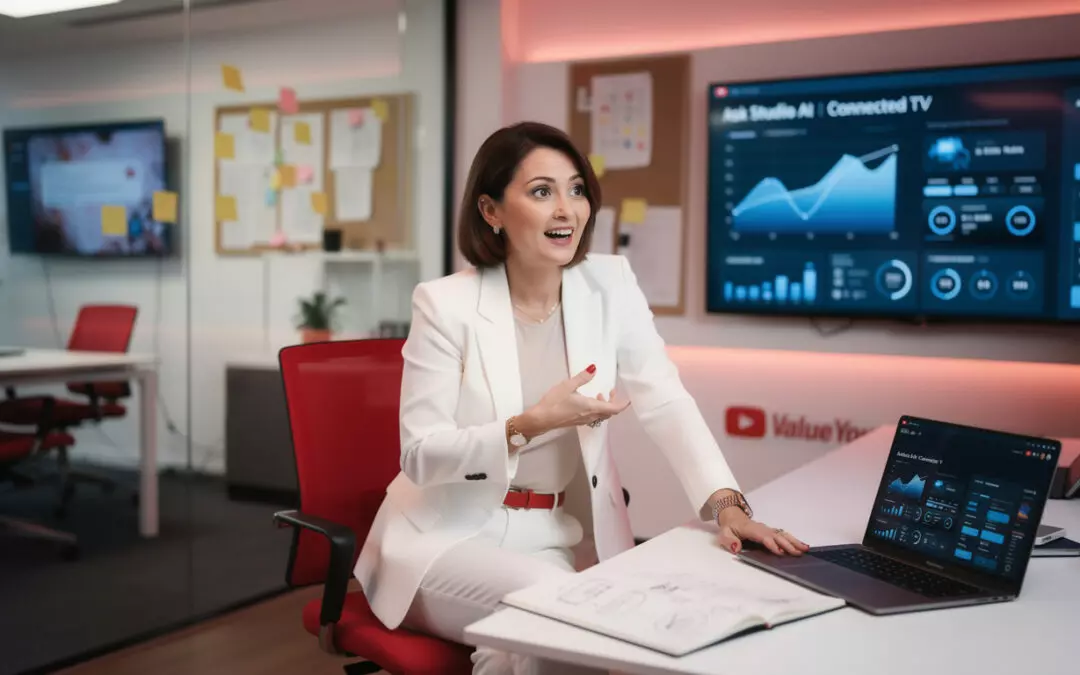
YouTube is improving its AI for Ask Studio and connected TV: CTV updates, Premium podcasts, Effects Maker, and creator impacts.
YouTube is improving its AI for Ask Studio and connected TV with a clear logic: reduce friction between search, creation, analysis, and video consumption. The platform no longer just recommends content. It now helps creators understand their data, viewers ask questions about videos, and brands rethink their formats.
The signal is clear. YouTube now claims one billion podcast listeners and viewers each month, a figure communicated by the platform in its recent announcements about the creator ecosystem. This scale explains the attention being paid to connected TV, Premium podcasts, and AI tools integrated into YouTube Studio.
YouTube is improving its AI for Ask Studio with more useful memory for creators
Ask Studio is getting a simple but important improvement: conversations no longer disappear as soon as the window is closed. Until now, a creator could ask the assistant to analyze performance, suggest format ideas, or summarize audience feedback, then lose the entire thread at the end of the session. This limitation reduced the tool’s strategic value.
The update changes that dynamic. Conversations are now automatically saved for 30 days. They appear in a searchable list and can be resumed later. Multiple threads can coexist: one for a Shorts series, another for an editorial calendar, a third for analyzing a drop in retention. In practical terms, Ask Studio is moving from a one-off assistant to a continuous workspace.
A concrete example to understand the impact on a YouTube channel
Camille, a fictional creator specializing in plant-based cooking, publishes three long-form videos per week and two Shorts per day. On Monday morning, she asks Ask Studio why her latest “batch cooking” format is keeping viewers less engaged after the fourth minute. The tool can cross-reference retention data, comments, and recently tested titles. On Thursday, Camille returns to the same thread, adds the numbers from a new video, and compares the hypotheses.
This scenario illustrates the value of conversational memory. A YouTube strategy rarely comes down to a single answer. It advances through iterations. A title is tested, a thumbnail is refined, a format is adjusted. With 30-day conversation storage, the creator keeps an actionable record of their decisions. In our experience, at ValueYourNetwork, the channels that grow fastest are often the ones that document their choices instead of changing direction with every post.
That said, AI does not replace human analysis. A chatbot can spot weak signals, but it can also overinterpret a one-off fluctuation. A video may decline because it is less clear, but also because it was published during a competing event or because the notification didn’t circulate as well. Ask Studio’s value therefore depends on the quality of the questions asked and the creator’s ability to compare suggestions with the facts.
- Keep one thread per project to avoid mixing editorial ideas, statistics, and business requests.
- Compare the answers with YouTube Analytics before changing a content strategy.
- Document tests on titles, thumbnails, durations, and video hooks.
- Use Ask Studio as a co-pilot, not as the sole decision-maker for creative choices.
For brands, this development also reinforces the value of ongoing partnerships. An influencer campaign on YouTube is not limited to a published video. It involves watch data, comments, related searches, and reactivation opportunities. Teams that already use AI tools to structure their social media strategy can integrate Ask Studio into a broader workflow, as long as they keep a clear process.
The strength of this update lies in its continuity. An assistant that temporarily remembers context becomes more useful for planning, refining, and learning. The key takeaway: on YouTube, AI becomes valuable when it supports an editorial process, not when it generates isolated answers.
YouTube is improving its AI for Ask Studio and connected TV in the CTV experience
The second development concerns connected TV. YouTube is extending its AI-assisted search mode to compatible smart TVs, game consoles, and streaming devices. The principle remains accessible: if the remote has a microphone button, users can start a voice search from the home screen or the YouTube search bar.
The new feature goes beyond standard voice dictation. Users can make more natural requests, such as “catch me up on the highlights of an awards ceremony” or “find some calm cooking videos about an hour long.” The platform interprets the intent and then suggests relevant content. During a video, certain interactions can also be used to ask questions related to the content being watched.
Why connected TV is becoming a strategic battleground
Television has long been associated with passive consumption. YouTube has been changing that behavior for several years. On the big screen, users watch filmed podcasts, live streams, tutorials, independent documentaries, creator-led shows, and hybrid entertainment formats. AI-assisted voice search reflects a reality: on a couch, no one wants to type a long query with a remote.
CTV therefore becomes a more natural touchpoint for long-form content. A sports brand can imagine a series of 45-minute workouts accessible by intent: “gentle workout to get back into it after an injury” or “cardio workout with no equipment.” A cultural outlet can organize its videos to answer conversational queries: “summarize the films nominated for the Oscars” or “explain this director to me in ten minutes.” A channel B2B can, for its part, create longer instructional videos, adapted to professional searches from a living room or meeting room.
This evolution also raises a simple question: are creators really preparing their content for voice search? Overly obscure titles, thin descriptions, and slow introductions may serve these new uses less effectively. On the other hand, videos structured with clear segments, precise chapters, and phrasing close to what users ask for may gain in algorithmic readability.
| YouTube AI feature | Main use | Impact for designers and brands |
|---|---|---|
| Ask Studio with 30-day history | Analyze a channel, track ideas, pick up conversations where you left off | Better strategic continuity and tracking of editorial tests |
| AI search on connected TV | Find videos with natural voice queries | Need to optimize titles, descriptions, and chapters |
| Enhanced Premium podcasts | Control playback speed and background playback | Smoother experience for long-form and audio-visual formats |
| Effects Maker with Google Nano Banana | Create Shorts effects with conversational prompts | Faster creative production, but a need for AI transparency |
The counterargument is worth raising. More guided search could reduce spontaneous discovery if results become concentrated around already well-optimized formats. Smaller creators will therefore need to be even clearer in signaling the value of their videos. That said, the tool could also benefit niche content, since a precise voice query may surface a specialized video more effectively than a generic keyword.
The topic fits into a broader trend: social networks are integrating AI into creation, search, and distribution. The analysis of the impacts of artificial intelligence on influencer marketing already shows that platforms are pushing creators toward formats that are more measurable, more adaptable, and more conversational.
The key takeaway is clear: connected TV is turning YouTube into a living-room audiovisual search engine. Creators who structure their content for this voice search will gain a real edge.
YouTube improves its AI for Premium podcasts and long-form content
Podcasts are playing an increasingly important role on YouTube. The figure of one billion monthly users for podcasts viewed or listened to on the platform sets the tone. It is no longer just an audio format imported from specialized platforms. On YouTube, the podcast becomes video, short clip, live stream, replay, sponsored segment, and in-depth content.
YouTube is adding two options for Premium subscribers on Android, with an arrival on iOS announced for later in the year. The first is automatic playback speed adjustment. The app can detect certain slower passages, such as a long setup, a less dense transition, or very measured speech. It then speeds up playback, up to 4x, before returning to the default speed when the pace picks up again.
Automatic speed changes how much users will tolerate lengthy stretches
This feature may seem technical, but its effect can be very concrete. In two-hour podcasts, listeners do not always leave an episode because they are no longer interested in the topic. Sometimes they drop off because of a stretch that is too slow, a drawn-out introduction, or a less informative exchange. Automatic adjustment offers an alternative to simply leaving.
Creators should not see this as permission to make episodes longer for no reason. If viewers are speeding up certain segments en masse, the editorial signal remains strong. A long introduction repeated in every episode can become tiring. A poorly integrated sponsored segment can trigger fast-forwarding. A discussion without clear progression can lose the audience. AI helps users stay, but it also reveals the format’s weak spots.
The second option improves background viewing. With the screen locked, the user can switch between audio and video, skip a chapter, go back, or adjust playback without unlocking the phone. This matters in everyday use. On public transit, in the kitchen, while walking, or between meetings, the YouTube podcast comes closer to a premium audio experience while retaining its video dimension.
For brands, this shift changes how partnerships are designed. A message integrated into a podcast can no longer rely on visuals alone. If the user is listening with the screen locked, the ad must still make sense in audio. Conversely, if the user returns to the image on a large screen, the set, objects, QR codes, and demonstrations can enrich the experience. A good setup therefore has to work in both modes.
A simple example: a nutrition brand sponsors a sports podcast. The creator presents the product orally, explains the context of use, and then displays a QR code for connected TV viewers. Listeners in the background get an easy-to-remember spoken code. TV viewers scan the offer. The same sequence covers two behaviors without forcing a single path.
Players tracking developments in generative AI platforms, from Meta to Google, know that the user experience is becoming more fragmented. Analyses on the integration of artificial intelligence into social networks confirm this direction: each platform adapts AI to its native uses rather than copying a single model.
The key takeaway is operational: YouTube podcasts need to be designed as modular content. They must remain fluid in audio, readable in video, and usable on both mobile and TV.
Effects Maker, Google Nano Banana, and transparency around YouTube AI
YouTube is not only working on analysis and search. The platform is also strengthening creation with Effects Maker, launched in August 2025 to let creators design their own effects for Shorts. The notable new feature is the integration of Google Nano Banana, designed to generate more complex effects from conversational prompts.
The benefit is obvious for creators who do not have scripting skills. Instead of coding an effect, they can describe the desired result: a futuristic studio atmosphere, a realistic visual transformation, a transition effect aligned with a brand identity, or a filter suited to a Shorts series. Precise Mode, meanwhile, aims for more realistic and better controlled outputs.
A creative gain, but greater responsibility
The promise is attractive. A beauty creator can generate a product spotlight effect. A music channel can create a visual signature for each clip. A fashion brand can test several artistic directions before a launch. Production speed increases, and short-form content gains variety.
One significant tension remains. In parallel, YouTube is developing systems to detect and label content generated or modified by AI. The platform therefore provides synthetic creation tools while strengthening transparency signals. This dual direction is not inconsistent if it is well explained: producing with AI is not the problem. Misleading the audience about the nature of content is more so.
For an influencer campaign, this nuance matters. An openly used AI effect can support a creative idea. A modified face without a clear mention can create a trust risk. A product demo that is too altered can disappoint at the moment of purchase. Brands must therefore include simple rules in their briefs: which effects are allowed, which elements must remain realistic, and what disclosure will be shown if the final result significantly changes the image.
This vigilance echoes the debates around virtual models, avatars, and synthetic content. Use cases are multiplying, but trust remains a scarce currency. The thinking around artificial intelligence applied to models and fashion influencers shows that creative performance is not enough. The public wants to understand what they are looking at.
An effective method is to separate three levels. The first concerns light enhancement, such as a color or a transition. The second involves visible transformation, with an openly creative effect. The third changes the perception of the product, the body, the place, or the performance. The higher you go through these levels, the more explicit the transparency must be.
This approach also protects creators. An influencer who explains their use of AI can highlight their artistic direction. A brand that frames these practices reduces misunderstandings. An informed audience often accepts experimentation more readily, especially when the content remains honest about what is real, simulated, or stylized.
The strategic point is clear: Effects Maker can accelerate Shorts creation, but trust will depend on usage rules. Creative AI becomes a powerful lever when it serves a recognizable idea and a transparent promise.
What YouTube improving its AI for Ask Studio and connected TV changes for influencer marketing
YouTube is improving its AI for Ask Studio and connected TV, but the impact goes beyond features. For influencer marketing, these announcements require a more methodical reading of content, audiences, and touchpoints. A YouTube campaign can no longer be thought of only around a main video and a few clips.
Creators now have a more persistent assistant with Ask Studio. Viewers are searching more naturally on connected TV. Podcasts are becoming more flexible to listen to. Shorts are gaining effects generated by prompts. Each piece changes part of the journey. The strategy therefore needs to connect the formats with one another: long-form, vertical clip, voice search, audio podcast, sponsored activation, and post-campaign analysis.
A campaign method adapted to new YouTube usage patterns
A brand launching a tech product can structure a campaign in several stages. First, a long video explains the problem, shows the product, and answers objections. Then, Shorts created with consistent effects restate the benefits in short formats. Next, a podcast segment expands on the product’s real-world use in a more natural discussion. Finally, Ask Studio helps the creator identify recurring questions in the comments and produce a follow-up video.
This method creates a cycle. Data feeds creation. Creation generates signals. Signals guide what comes next. AI does not make strategy disappear; it makes inconsistencies more visible. If a message is not clear, the comments show it. If a sequence is too slow, retention signals it. If a voice query does not find the video, the title and description need to be reworked.
According to information published by YouTube, the platform continues to invest in tools designed for creators, monetization, and AI-assisted experiences. This direction confirms a shift: value no longer comes only from audience size, but from the ability to organize content so it can be found, understood, reused, and measured.
ValueYourNetwork supports brands and creators in this evolution with expertise in influencer marketing since 2016. The agency has led hundreds of successful campaigns on social media, with particular attention to consistency between message, format, and audience. Its strength lies in its ability to connect influencers and brands around measurable objectives without losing the human dimension of content. To structure a YouTube campaign integrating AI, CTV, Shorts, and podcasts, contact us.
The final lesson is practical: brands should ask for less raw volume and more editorial logic. A video thoughtfully designed for YouTube Studio, connected TV, podcasts, and Shorts will be more valuable than a series of scattered pieces of content.
Frequently Asked Questions about YouTube improving its AI for Ask Studio and connected TV
Why is YouTube improving its AI for Ask Studio and connected TV?
YouTube is improving its AI for Ask Studio and connected TV to make creation, search, and viewing smoother. Ask Studio helps creators analyze their data, while AI on CTV makes natural voice searches easier.
How is YouTube improving its AI for Ask Studio in practical terms?
YouTube is improving its AI for Ask Studio with automatic conversation saving for 30 days. Creators can pick up multiple discussion threads, track their ideas, and compare their insights over time.
What does YouTube improving its AI for Ask Studio and connected TV change for brands?
YouTube is improving its AI for Ask Studio and connected TV by giving brands more data and more touchpoints. Campaigns need to incorporate long-form videos, Shorts, podcasts, voice search, and post-publication analysis.
Is YouTube improving its AI for Ask Studio and connected TV useful for small creators?
YouTube improving its AI for Ask Studio and connected TV can help small creators better structure their content. Clear titles, precise descriptions, and well-thought-out chapters can improve discoverability.
Does YouTube improving its AI for Ask Studio and connected TV pose risks?
YouTube is improving its AI for Ask Studio and connected TV, but creators need to stay vigilant. AI suggestions can be useful without replacing human analysis or transparency about generated or edited content.