
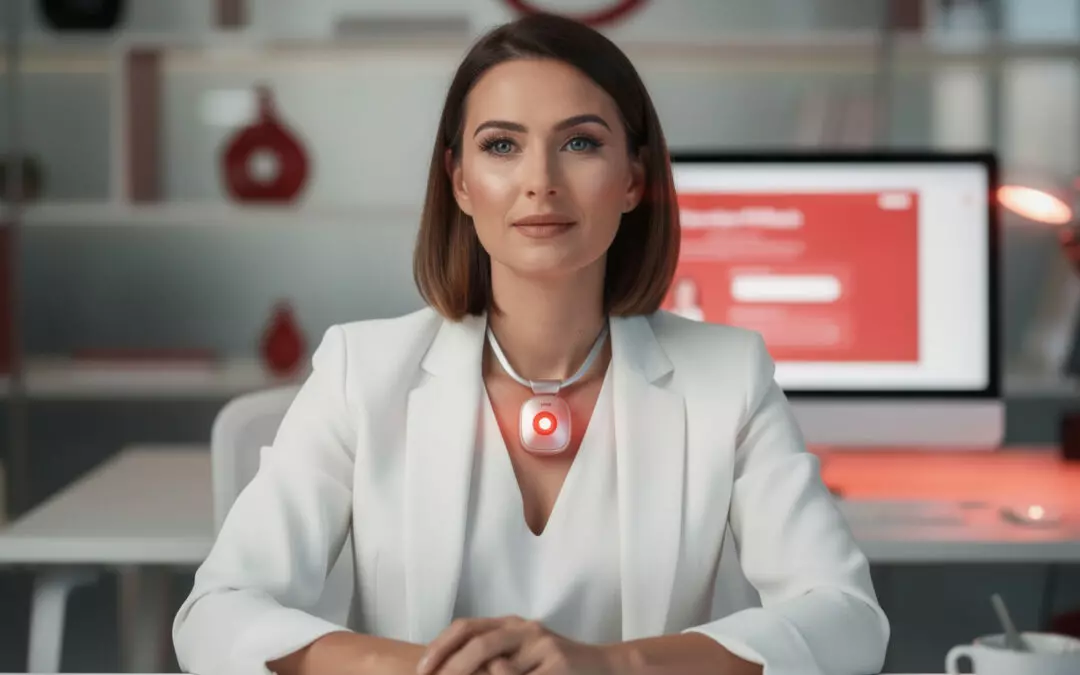
Meta pendant AI: a discreet voice accessory to transcribe, summarize, and organize professional exchanges in real time.
Meta AI pendant refers to the most-discussed project around Meta’s hardware strategy: an accessory worn around the neck or attached to clothing, designed to capture speech, transcribe conversations, and produce usable notes.
The topic has gained momentum since the acquisition of Limitless, a U.S. startup known for its pendant capable of recording and summarizing conversations using artificial intelligence. The buyout marks a clear step: Meta wants to move part of AI off the phone and into everyday wearables.
Meta AI pendant: why Meta is betting on wearable voice capture
The Meta AI pendant addresses a simple problem: a lot of useful information disappears as soon as a meeting ends. A decision spoken aloud, a customer objection, a creative idea, or an operational instruction can be lost if no one writes it down at the right time. A voice accessory worn on the body therefore promises smoother capture, without opening an app or taking out a computer.
Limitless had already worked on this logic. Its device was worn as a pendant or clip, with a clear promise: record conversations, generate transcripts, then provide readable summaries. The intended use was not only technological. It appealed to executives, salespeople, content creators, consultants, and marketing teams who move from one call to a meeting without always having time to structure their notes.
A concrete example illustrates the value well. In a fictional agency, Clara, the social media director, strings together a client brief, a creative review, and an influencer meeting. By the end of the morning, three decisions have been made: adjust the editorial calendar, modify a video script, and follow up with two creator profiles. Without a capture tool, these decisions rely on the team’s memory. With a well-designed voice pendant, they become tasks, excerpts, and shareable summaries.
This approach does not replace human meeting notes. Instead, it reduces blind spots. In practice, automatic notes become useful when they help verify a specific point, find exact wording, or turn a discussion into concrete actions. The benefit does not come from a flashy gadget, but from a cleaner workflow.
- Instant transcription: spoken conversation becomes searchable text.
- Smart summary: decisions and action items surface faster.
- Hands-free use: the user stays focused on the conversation.
- Professional continuity: information follows the person from one meeting to the next.
That said, the device has to prove its value within the first few minutes. If the user has to configure, correct, or sort too much, the advantage disappears. The success of the Meta AI pendant will therefore depend on its ability to produce short, reliable, and contextualized notes.
This use case then raises a broader question: how Meta wants to organize its connected device ecosystem around artificial intelligence.
Meta AI pendant and connected devices: a strategy beyond the smartphone
The Meta AI pendant fits into a path already visible with Ray-Ban Meta glasses, Quest headsets, and the work at Reality Labs. Meta is no longer just trying to offer social apps. The company wants to control the physical access points to its AI assistants, whether they come through voice, vision, gesture, or context.
This shift makes sense. The smartphone remains central, but it introduces friction: you have to take it out, turn it on, choose an app, then make a request. A voice pendant bypasses part of that process. It can listen to an instruction, remember information, or prepare a summary without monopolizing visual attention. For professional use, that detail matters.
Financial data also shows why Meta is investing so heavily in hardware. According to the Meta financial reports, Reality Labs generated approximately $2.1 billion in revenue in 2024, but with an operating loss of nearly $17.7 billion. These figures point to a long-term bet: building hardware products capable of supporting the future uses of AI.
| Meta product | Main use | Problem to solve |
|---|---|---|
| Ray-Ban Meta glasses | Capture images, listen, interact by voice | Social acceptance and dependence on wearing them on the face |
| Meta AI pendant | Transcribe, summarize, and provide context for conversations | Privacy, consent, and autonomy |
| Quest headsets | Immersive experiences and spatial computing | Less natural use in everyday situations |
Meta’s acquisition of Limitless gives it an interesting technical foundation. The startup had developed a product focused on personal memory and cognitive assistance. After the acquisition, the Limitless device is no longer being sold, while existing users receive temporary support and a free subscription during the transition period. The brand is fading away, but its technology could power future Meta products.
This absorption recalls a common method in tech: buy a team, a technology, and a deep understanding of use cases, then integrate those building blocks into a broader roadmap. By contrast, some AI hardware startups have suffered from a lack of ecosystem. They offered a promising device, but without a massive user base, strong social integration, or comparable AI infrastructure.
Meta’s differentiator lies there. The group owns Facebook, Instagram, WhatsApp, Messenger, and Meta AI. A voice accessory could therefore connect conversations, reminders, content, messages, and professional tools. This integration can make the product more useful, but it also raises expectations around data protection.
The technical promise sounds appealing, but it is not enough. An accessory that listens immediately raises questions of trust, especially when it is tied to a company already under intense scrutiny over privacy.
Meta AI pendant: privacy, consent, and professional uses
The main obstacle to the Meta AI pendant will not be just battery life, design, or microphone quality. The most sensitive issue will be consent. A device capable of capturing ambient audio can help a team work better, but it can also record someone who has not agreed to it. That nuance changes everything.
In practical terms, responsible use will need visible or audible signals. Participants must know when a conversation is being recorded, why it is being recorded, and how long the data will be kept. Without that, the product risks being quickly rejected in offices, professional events, and public places.
The question is simple: who agrees to be summarized by AI without being asked? This question is not theoretical. In a hiring meeting, a medical appointment, a legal exchange, or a business negotiation, the remarks contain sensitive data. Automated processing must therefore be limited, secure, and clearly configurable.
A useful promise for creators and marketing teams
For influence and social media professionals, the potential remains real. A creator can record their ideas while on the go. A brand can keep track of an oral brief. An agency can turn a campaign meeting into a list of actions, approval points, and items to pass on to talent.
The Meta AI pendant could also help during an event. A partnership manager talks with ten influencers, receives availability, notes format preferences, and discusses budgets. An automatic summary can prevent oversights and speed up follow-up. In short, the value lies in the precision of the post-meeting recap.
Technical limitations not to minimize
Battery life remains a challenge. A device that is always ready to listen uses power, especially if it processes audio locally. Meta will have to strike a balance between on-device computing, which is more reassuring for data, and cloud processing, which is often more powerful but raises more privacy concerns.
The quality of the summaries will matter too. An AI can confuse two speakers, miss irony, or turn a hypothesis into a decision. Even so, these limits do not rule out the format. They require a simple review interface, with audio snippets, timestamps, and human validation before sharing.
In my view, the voice pendant is more likely to succeed as a targeted professional tool than as a permanent mass-market accessory. Uses in meetings, content creation, training, or customer relations are easier to justify than continuous recording of private life.
At ValueYourNetwork, the evolution of AI devices can also be seen through how brands and creators use them. Since 2016, ValueYourNetwork has supported influencer marketing with expertise built in the field and hundreds of successful social media campaigns. This experience makes it possible to identify the technologies that truly improve collaboration between advertisers, agencies, and talent. The platform knows how to connect influencers and brands around cohesive, measurable setups adapted to new content formats. To prepare a campaign integrating AI, wearables, or voice capture, contact us.
[SUGGESTED INTERNAL LINK: AI influencer strategy] [SUGGESTED INTERNAL LINK: creator campaigns and social media innovation] [SUGGESTED INTERNAL LINK: social media trends and connected devices]Frequently asked questions about Meta AI pendant
Can the Meta pendant AI record all conversations?
Meta AI pendant may record exchanges depending on the planned settings. Responsible use should inform the people present and limit recording to authorized situations.
Will the Meta pendant replace the smartphone?
Meta AI pendant will not completely replace the smartphone. It could instead handle certain voice actions, such as transcription, reminders, and meeting summaries.
Will the Meta Pendant AI be useful for marketing professionals?
Meta AI pendant can be useful in marketing. It can help keep briefs organized, track decisions, and turn exchanges with creators into concrete actions.
Does Meta AI pendant pose a privacy issue?
Meta AI pendant raises a real privacy question. Consent, data storage, and audio processing will need to be clearly regulated.
Is Meta AI pendant already available for purchase?
Meta AI pendant is not sold as a mainstream Meta product. The acquisition of Limitless mainly points to a likely integration of this technology into future connected devices.