
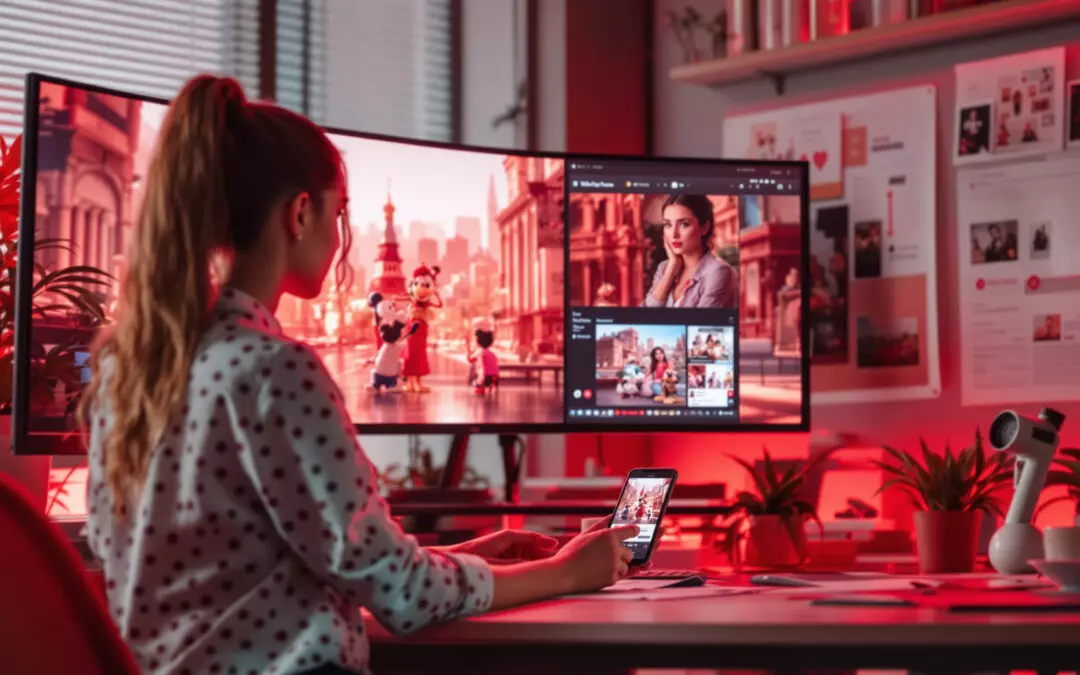
Hexed, Disney's upcoming feature film scheduled to hit theaters on November 25, 2026, is being criticized because its first teaser appears to frame the image to survive Instagram and TikTok's vertical cropping. The complaint focuses mainly on the centering of the characters, action, and visual effects, which seem more compatible with mobile feeds than with staging fully designed for the big screen.
Hexed: why the teaser sparked controversy
Disney presents Hexed as an “only in theaters” release dated November 25, 2026, with the film still listed as “Not Yet Rated” on its official page. The project is directed by Fawn Veerasunthorn and Jason Hand, with Josie Trinidad as co-director, Roy Conli and Yvett Merino producing, and a voice cast that includes Hailee Steinfeld, Rashida Jones, Tracey Ullman, and Stephen Fry.
The issue is not the existence of a social campaign around the film. That is normal. Since 2015, every theatrical launch has also lived on Instagram, TikTok, YouTube Shorts, and X. The criticism, relayed on June 20, 2026 by Clubic and Creative Bloq after the first teaser was released in mid-June, centers on a more specific impression: the image may have been built to be cropped to 9:16 without losing the important elements.
Disney places the story in Hexe, “the world of witches.” TheWrap had already reported on August 31, 2025, that the film had been presented at Destination D23 as following an awkward teenager and his very organized mother. That narrative foundation was then viewed through a highly social lens: what does the film look like when it moves from the big screen to a phone held vertically?
Center-framed composition, the signal that annoys viewers
In the criticism published by Clubic and Creative Bloq, the recurring point is the same: the characters, magical effects, action, and sometimes the plot-relevant details seem to be placed in the center of the image. This choice makes vertical recropping for Reels, TikTok, or Shorts easier, since the left and right edges become less essential.
In practice, it's a genuine production process social media. When a brand knows that a clip will need to work in 16:9, 1:1, 4:5, and 9:16 aspect ratios, it often requests a central “safe zone.” The pitfall is that in animation or film, this caution can flatten the composition. Fewer diagonals. Less breathing room. An image that works everywhere, but makes less of an impact.
Creative Bloq specifically cites a June 17, 2026 test posted on X showing the Hexed teaser recropped to vertical 9:16. It is exactly the kind of demonstration that energizes creative communities: one video, and everyone immediately understands the suspicion visually.
Honestly, the debate is not absurd. Marketing teams have been asking for “social-first” assets for years. But a feature-film trailer is not a native TikTok ad. When the social intention becomes visible in the staging, audiences notice it.
Instagram, TikTok, Shorts: why vertical shapes creation
Since TikTok's explosion in Europe between 2019 and 2021, followed by Instagram's response with Reels in 2020 and YouTube's with Shorts, 9:16 has become the most aggressive discovery format. Not necessarily the noblest. The most distributed, yes. For a family franchise, ignoring those streams would be a commercial mistake.
Hexed highlights a tradeoff advertisers know well: should you create first for the distribution channel or for the work itself? On Instagram, a shot that is too wide loses the user in less than two seconds. On TikTok, important action placed to the side can be hidden by the interface, caption, or engagement buttons. On YouTube Shorts, the same clip has to remain understandable without context.
Connected TV adds another layer. Reels now reach the living room too, as shown by the evolution ofInstagram on Samsung Smart TV, while YouTube is also pushing its video use on the big screen with its AI and connected-TV features. A film campaign therefore has to work on mobile, desktop, television, and in theaters. Not easy.
| Platform or channel | Dominant format in 2026 | Concrete impact on a film clip |
|---|---|---|
| TikTok | 9:16 vertical | Center action, immediate readability, lateral interfaces should be avoided |
| Instagram Reels | 9:16 vertical | Faces and movement must remain legible in the mobile feed |
| YouTube Shorts | 9:16 vertical | Standalone clip, quick hook, strong reframing constraints |
| Classic YouTube | 16:9 horizontal | Wider composition, better room for scenery and depth |
| Cinema | Horizontal projection | Staging designed for space, edges, and the rhythm of the shot |
The real lesson for creators: do not confuse vertical compatibility with vertical writing. A clip can be reframable without looking trapped in a mobile grid. In this niche of animated cinema, it is better to produce several intentional versions than one master that is too neutral.
What this case says about cinema marketing in 2026
The Hexed controversy comes at a time when studios are no longer selling just a screening. They are selling shareable moments. A character, a reaction, a setting, a magical shot: each element can become a clip, a meme, a fan edit, or a commentary video.
For brands, this is exactly the logic described in strategies influencer marketing in 2026 : proving effectiveness at every stage, from discovery to purchase. A trailer becomes a media asset, a creator support, a pretext for discussion, and sometimes a perception test even before release.
The risk is letting social media codes seep into the cultural object to the point of making it feel like a film calibrated for the algorithm. Younger audiences know how to spot those signals. Creators do too. Since 2020, they have been seeing briefs asking for “a centered shot,” “a hook in the first second,” “a safe version for Reels.” When they see those instincts in a Disney trailer, they react quickly.
Another factor is fueling the discussion: Creative Bloq reports that character design criticism had already begun in April 2026, around a change in the main character from a boy to a girl. Clubic, for its part, indicates that the French title would be “Billie to the Worlds Crossroads.” These elements, reported by separate sources, show one thing above all: attention around the project was already sensitive before the framing debate.
Useful lessons for creators, studios, and advertisers
The Hexed controversy is a good case study for everyone who creates video content. The public does not reject vertical. It rejects the feeling that creation is kneeling before the feed. A major distinction.
- Create a strong 16:9 version before producing the social cutdowns: if the master is weak, 9:16 will not save it.
- Define safe zones, but keep shots where the edges tell part of the story: setting, threat, visual gag, secondary glance.
- Test your clips in the actual interfaces of TikTok, Instagram Reels, and YouTube Shorts, not just in editing software.
- Avoid centering every shot: a few asymmetrical compositions are enough to bring back a cinematic feel.
- Brief creators with assets designed for vertical viewing rather than with a trailer hastily cropped to fit.
For an influencer campaign, the strongest approach is to separate the use cases. The cinematic teaser should establish the world. Creator formats should spark conversation. Short videos should simplify access without reducing the work to a series of perfectly centered shots.
All micro-communities fuel this kind of debate, especially when they blend animation, design, film, and TikTok culture. That’s exactly what we’re seeing with the microcultures on social media : a highly technical critique can go viral if it taps into a code shared by an active community.
A case study for reading social-first campaigns
Hexed is not doomed by this controversy. The film has not been released yet, its official rating has not been published, and a teaser is not enough to judge a complete mise-en-scène. But the accusation reveals a deeper shift: viewers now analyze formats like content professionals.
For creators, this is an opportunity. A framing analysis, a 16:9 versus 9:16 split-screen, an educational video about the safe zone, or a comment on the difference between a teaser and a native clip can perform very well, especially if you avoid an accusatory tone. Audiences like to understand. Not just complain.
Advertisers, for their part, should remember a simple rule: creativity should not be invisible under media constraints. Trends like the comment as creative show that platforms reward conversational formats, but that does not replace real art direction. For a cultural launch, the best social content respects the work while speaking the language of the feed.
ValueYourNetwork helps brands, creators, and talents navigate these trade-offs between formats, algorithms, and public perception; whether you are influencer Whether you're an advertiser or a business, grow your social media presence with us and contact us to develop a strategy that covers both content creation and distribution.
FAQ about Hexed and the Instagram TikTok controversy
Why is Hexed being accused of being made for TikTok?
Because several observers felt the teaser placed the characters, action, and effects at the center of the image, which makes it easy to reframe vertically in 9:16 for TikTok, Instagram Reels, and YouTube Shorts.
When does Hexed come out in theaters?
Disney says Hexed is “only in theaters” on November 25, 2026. The film’s official page also says it is still “Not Yet Rated.”
Who is directing Hexed at Disney?
The film is directed by Fawn Veerasunthorn and Jason Hand, with Josie Trinidad as co-director. Disney lists Roy Conli and Yvett Merino as producers.
Does vertical framing mean a film is worse?
No. A frame that’s compatible with social media is not a problem in itself. It becomes an issue if the constraint is so visible that it impoverishes the composition or gives the impression of content designed primarily for the feed.