
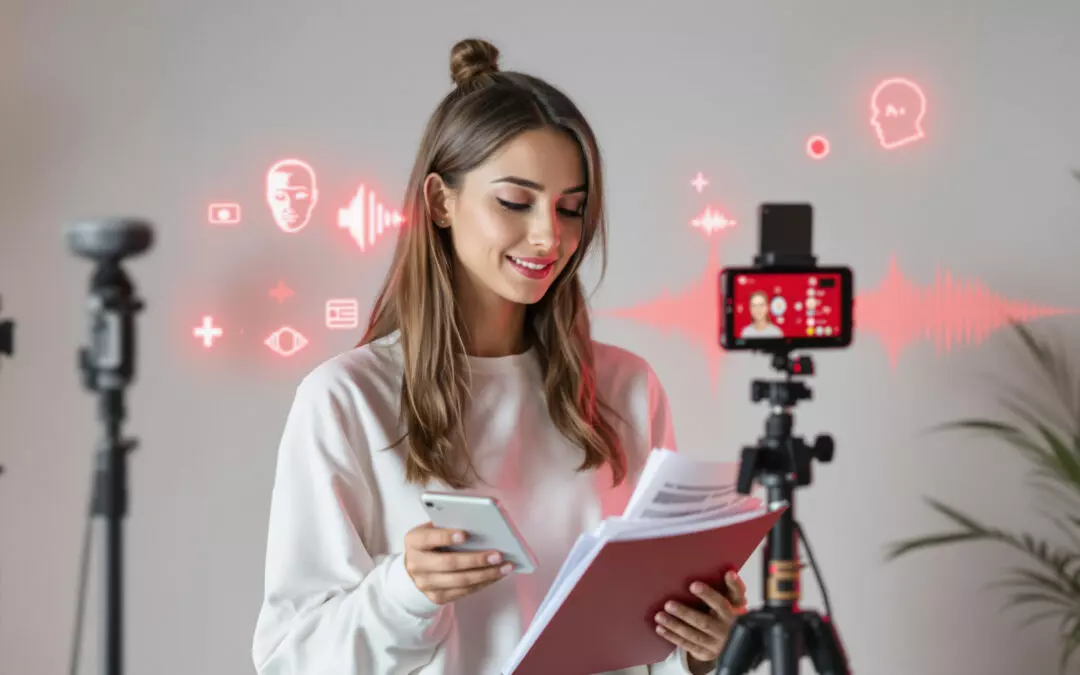
To protect your content from AI-generated clones by influencers, you need to take action before the copying happens: lock down your originals, prove the prior existence of your creations, limit exploitable sources, and prepare a takedown procedure. The risk no longer applies only to celebrities. A voice taken from a podcast, a face taken from a Reel, or a TikTok video can be enough to create a convincing fake that is monetized or used to scam your community.
Protecting Content from AI-Generated Clones by Influencers: Always Think About Evidence First
Since 2015, I’ve seen fake Facebook contests, Instagram impersonations, copied YouTube channels, and then AI avatars. The difference today is speed. Stolen content no longer always looks like a repost: it can imitate your voice, your posture, your way of selling.
The CNIL classifies deepfakes—or hyper-manipulations—as risks to privacy and identity theft when a face, voice, or behavior is faithfully reproduced. For a creator, it’s also a business issue: loss of trust, fake partnerships, misrepresented affiliations, and unfair negative publicity.
Your first line of defense isn’t magic. It’s a well-organized file of evidence. Keep your source files, publication dates, campaign contracts, raw footage exports, timestamped screenshots, and URLs. Honestly, many influencers wait until a dispute arises to organize their assets. By then, it’s too late.
What Platforms Are Already Doing to Combat Deepfakes
Platforms are making progress, but they do not automatically protect everything. In 2024, YouTube expanded its privacy complaint process: an individual, or their legal representative, can request the removal of AI-generated or synthetic content that simulates their face or voice, provided they are uniquely identifiable.
In April 2024, Meta announced a change in approach on Facebook, Instagram, and Threads: rather than focusing on removing a narrow category of manipulated videos, it will label a broader range of AI-generated content. This is useful for transparency, but a label does not always repair the commercial damage.
On TikTok, the updated community guidelines state that content using AI or editing to realistically depict people or scenes must be clearly labeled. TikTok Shop also specifies that synthetic faces, synthetic voices, digital humans, or realistic virtual figures must be disclosed in video or audio content.
| Platform or authority | Measure cited | Year | Practical limitation |
|---|---|---|---|
| YouTube | Possible Complaint Against AI-Generated Content That Simulates a Recognizable Face or Voice | 2024 | Case-by-case request, with identifying information |
| Meta | Expanded labeling of AI-generated content on Facebook, Instagram, and Threads | 2024 | The label does not necessarily prevent the initial release |
| TikTok | Requirement to Disclose Realistic Images Created or Modified by AI | 2025 | Application varies depending on context, account, and country |
| CNIL | Deepfakes Identified as Risks to Privacy and Identity Theft | 2026 | A useful framework, but the harm must be documented |
| PHAROS | Reporting Illegal Online Content via Ma Sécurité | 2026 | Reserved for content that may be illegal |
For a brand campaign, also ask the advertiser what steps they take if fake content uses your image to sell the same product. This point should be included in influencer contracts, along with usage rights, the duration of the campaign, and industry exclusions. To approach this topic from a business perspective, also review the best practices outlined in Performance-Based Influencer Marketing.
Limit the materials that the AI can suck up
The beginner’s trap: posting the same clean, high-quality video everywhere—without a watermark, without context, and with an isolated voiceover. It’s convenient for distribution. It’s also an excellent training tool for anyone who wants to imitate you.
You’re not going to stop showing your face. Your profession relies on your presence. But you can reduce the quality of public copies: keep the masters private, add subtle visual effects, use cutaways, vary the soundscapes, and avoid leaving long sequences of bare voice without music or ambient noise when it’s not necessary.
On Instagram Reels and TikTok, an embedded caption, a subtle logo, or a recurring visual element makes it harder for others to repurpose your content. It’s not foolproof. But in this niche, it’s better to create small hurdles than to look for a silver bullet. Creators who refine their visual identity are often a step ahead; the topic ties directly into the visual brand content and immediate recognition.
Don’t forget about internal metadata, either. Organize your files by date, campaign, client, platform, version, and associated rights. When a copy appears, you need to be able to quickly prove that the source content belongs to you or that it was produced within a specific context.
Content Credentials, Watermarks, Provenance: Useful, but Not Enough
Content Credentials, defined in the C2PA 2.2 technical specification in 2025, are signed provenance data attached to a digital file. They can document the origin and editing history of a piece of content, and sometimes indicate whether it was captured by a camera, generated by AI, or edited in a tool such as Photoshop.
Adobe has provided information about this provenance data; LinkedIn notes that it can display available metadata such as the source and revision history; and some C2PA-compatible cameras are already available. In particular, Digital Camera World noted in 2026 that the Leica M11-P was the first camera to incorporate C2PA-compliant provenance information at the time of capture.
But beware of a false sense of security. Academic research published in 2026 highlighted technical limitations in C2PA-type provenance systems, as well as potential contradictions between provenance metadata and watermarking signals. In practical terms: use these tools as a layer of evidence, never as a complete shield against deepfakes.
For an influencer, the right approach is like a chain: capture or export with attribution whenever possible, archive the originals, publish with branding, actively monitor, and then report any issues promptly. If you’re already using AI tools to edit your Reels or Shorts, keep a record of each step. The use of AI in social media content creation is evolving rapidly, as also shown by the analysis of AI in Instagram Edits on a Computer.
Anti-impersonation measures to be implemented starting this week
The most effective security is rarely spectacular. It comes down to a weekly routine. One well-run hour can prevent days of crisis, especially if you manage an engaged community or run sales operations with promo codes.
- Create a folder for each piece of important content, including the master video, published export, thumbnail, script, invoice or brief, screenshots of the posts, and dates.
- Set up regular searches for your name, username, brand name, slogans, promo codes, and catchphrases.
- Keep an eye out for recent accounts that repost your photos, bios, links, or past high-performing content.
- Include a clause in your contracts addressing deepfakes, the use of synthetic voices, the duration of rights, and liabilities in the event of impersonation.
- Prepare a template for a takedown request that includes the URL, screenshots, proof of identity, proof of prior use, and a description of the harm.
Brands must take the same approach when selecting influencers. A fake creator, fake followers, or a cloned image can ruin a campaign’s ROI. That’s why the methods for identifying fake followers on influencers become complementary to identity and reputation verification.
Another point that’s often overlooked: location. An impersonation becomes more dangerous if it combines your face, your voice, and your geographic habits. On Instagram, managing location data is something that deserves serious attention, especially using the settings described in this guide for Limit the sharing of your location.
What to Do If Your Voice or Face Has Already Been Cloned
Don't start by commenting publicly on the false content. Document it first. Take screenshots, record your screen, copy the URLs, note the date, the account, the platform, and any visible view counts if they appear, and keep all evidence of your audience's confusion.
Next, use the platform’s native reporting tools: file a YouTube privacy complaint if your face or voice has been simulated and you are recognizable; report TikTok for unreported or misleading AI content; and report Instagram or Facebook depending on the nature of the content. If a brand is involved, notify them quickly with factual information, not a panicked message.
In France, the CNIL recommends compiling a file of evidence in the event of identity theft. Its webpage references Article 226-4-1 of the Penal Code: identity theft is punishable by one year in prison and a fine of 15,000 euros. For illegal online content, the official PHAROS portal is accessible via Ma Sécurité and covers, in particular, threats, insults, discrimination, harm to minors, and other illegal content.
If the issue involves a paid campaign, involve your agency, your attorney, or your representative. Major tech companies are coordinating more closely on online fraud, a topic that ValueYourNetwork has already covered in relation to the alliance between Google, Microsoft, and Meta Fight Fraud, but your speed is still crucial during the first few hours.
ValueYourNetwork supports creators and brands with social media strategies, influencer selection, brand protection, and campaign performance. Whether you’re an influencer or an advertiser, contact us to grow your social media presence using a proven approach.
FAQ on AI Cloning of Influencers
How can you protect your content from being cloned by AI influencers on Instagram and TikTok?
Keep your source files, add visual brand markers, limit standalone exports without context, and monitor accounts that use your image. Promptly report any undeclared or misleading realistic AI content using the platform’s tools.
Can a deepfake of my voice be removed from YouTube?
Yes, since 2024, YouTube has allowed you to request the removal of AI-generated or synthetic content that simulates your face or voice if you are uniquely identifiable. Be prepared to provide proof of identity and evidence showing the simulation.
Do Content Credentials Prevent AI Cloning?
No. Content Credentials can help prove a file’s origin and history, but research from 2026 points to technical limitations. It is a useful form of proof, not comprehensive protection.
Should you file a complaint in the event of identity theft by AI?
If the content causes you harm or is used to deceive others, gather evidence and seek advice from a legal professional. In France, identity theft is covered by Article 226-4-1 of the Penal Code.