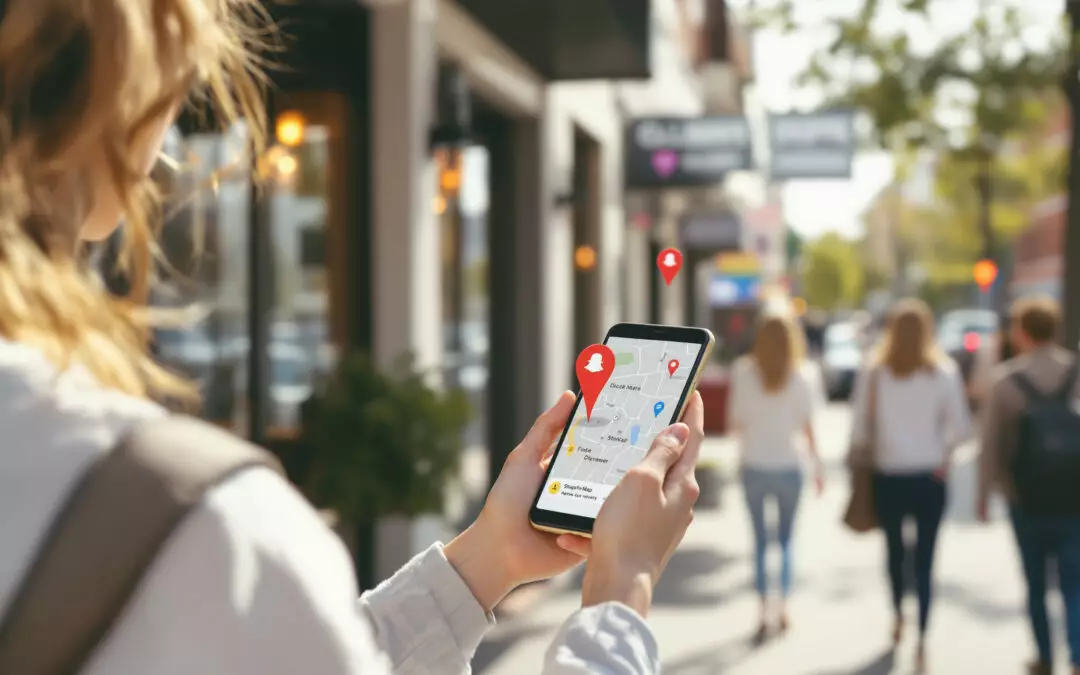
Snap Map advertising allows businesses to make their locations appear on Snapchat’s social map in order to generate discovery, engagement, and visits. In 2026, Snap Map surpassed 450 million monthly active users worldwide. Local effectiveness exists, but only foot-traffic measurement solutions can distinguish stated intent from an actually observed visit.
How does Snap Map advertising work in 2026?
Snap Map advertising relies primarily on Promoted Places, sponsored placements that Snap has been testing since 2024. A business can highlight its locations, facilitate the opening of a Place Profile, and direct users to get directions, chat with friends, or potentially visit a store.
Promoted Places fits into an already social use of mapping. Unlike a utility map consulted solely to find an address, Snap Map displays places associated with friends, outings, and conversations on Snapchat. Local advertising therefore appears when users are looking for an idea or coordinating an activity.
The documented journey in 2026 generally follows four steps: discovering a sponsored place or one associated with a friend, sharing or coordinating in Chat, opening the place listing or directions, and then potentially visiting. Beware of a common shortcut: opening a listing is not the same as entering a store.
Snap comptait aussi 971 millions d’utilisateurs actifs mensuels sur Snapchat au deuxième trimestre 2026, selon ses résultats financiers. La plateforme n’a toutefois pas publié de nouveau total pour Snap Map après le seuil de 450 millions communiqué en 2026. Pour situer ses codes face à Meta, notre comparaison entre Snapchat and Instagram for Stories helps explain the differences in usage.
Does Snap Map advertising really attract customers?
Snap Map advertising can generate incremental visits, but results depend on the measurement protocol. Carl’s Jr. recorded an incremental lift in visits of 18.1 % between July 30 and September 7, 2025, according to an InMarket foot-traffic study cited by Snap in 2026.
The Maps as Social Utility study published by Snap on October 15, 2026, offers another perspective. Conducted among more than 17,000 people ages 13 to 44 in the United States, Canada, the United Kingdom, France, Germany, and Saudi Arabia, it found that 71 % of respondents said they were open to visiting a place after seeing it as a sponsored pin.
This 71 % rate measures stated openness, not observed visits. In an advertising test conducted in 2026 with more than 11,000 participants, supplemented by a post-exposure survey of 2,100 users, Promoted Places was 9 points easier to notice, 5 points more appealing, and 4 points more interesting to click than sponsored pins on utility maps.
Between 14 and 25 days after exposure, users who had seen Promoted Places also said they were 1.1 times more likely to visit a store. Again, this is self-reported. Frankly, presenting this ratio as proof of in-store traffic would be a methodological error.
| Advertiser | Sector and market | Published result | Type of measurement |
|---|---|---|---|
| Carl’s Jr. | Restaurant, United States | 18.1 % incremental lift in visits in 2025 | Visits measured by InMarket |
| Aéropostale | Trade | 13 % Place Action rate and 8 % increase in foot traffic in 2025–2026 | Actions and observed foot traffic |
| Foot Locker | Retail, Australia | 4 million people reached and 650,000 interactions with the map in 2025–2026 | Reach and interactions |
| Bouygues Telecom | Telecommunications, France | 73 million store impressions, €0.12 per listing opening, and €0.92 per measured visit in 2026 | Exposure, action, and measured visit |
| Tropical Smoothie Cafe | Restaurant, United States | 45.2 % lift in visits, 5.69 ROAS, and 1.36 $ CPM in 2026 | Results reported by Snap; the foot-traffic provider was not identified in the publicly displayed methodology |
Which businesses can use Promoted Places?
Promoted Places is best suited to restaurant chains, stores, local services, and events with a usable address. The clearest campaigns connect an immediate reason to travel, such as a limited-time offer or local activation, with the nearest point of sale on Snap Map.
Restaurants: Put the product before the address
For a restaurant, displaying only a logo on the map is often not compelling enough. In 2026, Tropical Smoothie Cafe associated nearby locations with the limited-time Watermelon Mojito promotion, then separated measurement of incremental visits from clicks and ROAS. The product created the desire; the map reduced the distance to the store.
McDonald’s France had already placed more than 1,600 restaurants on Snap Map in 2025. The campaign generated a paid reach of 13.2 million people, an incremental reach of 3 million, a 5-point lift in action intent, and a 7-point lift in the perception that it was easy to find a restaurant.
Retailers: Pair video with a nearby store
In retail, Snap Map advertising benefits from being preceded by a video format that introduces the product or collection. Aéropostale combined video awareness with nearby store pins, reporting a Place Action rate of 13 % and an observed 8 % increase in foot traffic in 2025–2026.
This approach extends the possibilities of immersive advertising on Snapchat. The creative captures attention, while Snap Map turns that attention into measurable local action.
Events: Create a social landmark
An event can connect creator content or an augmented-reality experience to Promoted Places. In 2026, Eyewa’s Saudi campaign around the World Cup used a creator’s Bitmoji to guide users to nearby stores. Eyewa reported a Place Action rate of 11.46 %.
In this niche, a local creator recognized by the community is preferable to a celebrity far removed from the location. The content must provide a precise reason to travel: a meet-and-greet, launch, limited availability, or experience accessible on a specific date.
How much does Snap Map advertising cost?
No standard public Snap Map advertising rate was available in 2026. Case studies instead publish campaign-specific metrics: CPM, cost per Place Profile open, cost per measured visit, or return on ad spend. The budget therefore depends on the market, targeting, timing, and number of locations.
Bouygues Telecom’s French campaign, running from April 16 to May 4, 2026, provides a concrete benchmark: €0.12 per store profile open and €0.92 per measured visit, based on 73 million reported store impressions. These costs do not constitute a rate card that can be applied to an independent business.
Ask for an estimate based on your catchment area and actual objective. A low cost per profile open may seem attractive while masking few visits. Conversely, a higher CPM may still be profitable if incremental sales cover the media cost and promotional offer.
The right trade-off is to calculate a maximum cost per incremental visit based on average basket value, margin, and in-store conversion rate. This discipline is consistent with the challenge of measuring influencer campaigns : the easiest metric to obtain is not always the one that proves commercial value.
How do you launch and measure an effective local campaign?
An effective local campaign on Snap Map starts with a measurable objective, properly completed business listings, and creative tied to a reason to visit. In 2026, the strongest approach separates reach, Place Actions, directions, observed visits, and sales to avoid attributing every interaction to in-store traffic.
Here are the steps to define before going live:
- Define a single primary objective: profile open, directions, incremental visit, or in-store sale.
- Select participating locations and verify their addresses, hours, and the consistency of the local offer.
- Create an immediately understandable message featuring a product, event, or limited availability.
- Link the campaign to Snapchat videos, augmented reality, or a local creator when this support improves recall.
- Plan for a comparison group or a foot-traffic measurement provider if the objective concerns incremental visits.
- Analyze CPM, cost per Place Action, cost per measured visit, and attributable sales separately.
The pitfall beginners overlook involves pre-existing social influence. In 2026, Snap stated that 65 % of Snapchatters’ visits to new places involved locations their friends had visited during the previous year. This correlation proves neither that Snap Map caused the visit nor that an ad triggered it.
Documentez aussi l’exposition aux autres leviers : vidéos, créateurs, affichage local, promotions CRM et referencing cartographique. Une global campaign adapted to each local market requires distinct creative and catchment areas, especially when it covers multiple cities or countries.
Whether you are influencer ou annonceur, ValueYourNetwork met son expérience des réseaux sociaux et de l’influence marketing au service de campagnes locales mieux cadrées : contactez-nous pour développer vos réseaux sociaux avec nous.
FAQ about Snap Map and Promoted Places
What is the difference between Promoted Places and a regular pin?
Promoted Places refers to sponsored placements integrated into Snap Map. A standard pin corresponds to a place shown on the map without any advertising promotion purchased by a business.
Can in-store visits be measured with Snap Map?
In-store visits attributed to Snap Map may be estimated using an independent foot traffic study and a comparison group. Clicks, directions, and Place Profile opens alone do not prove a physical visit.
What is the Place Action rate on Snapchat?
The Place Action rate measures the share of exposed users who take an action associated with the location, based on the scope selected for the campaign. This metric should not be confused with an observed visit rate.
How does Place Loyalty work on Snap Map?
In 2026, award Gold, Silver, and Bronze Loyalty badges to visitors belonging, respectively, to the top 1%, 10%, and 25% of a venue’s most frequent visitors, based on visits made during the previous year.
Can a small business advertise on Snap Map?
A small business can consider Snap Map advertising if it has an identifiable retail location, a sufficiently large catchment area, and a concrete reason for people to visit. However, no standard public pricing was published in 2026, so requesting a tailored estimate is necessary.