
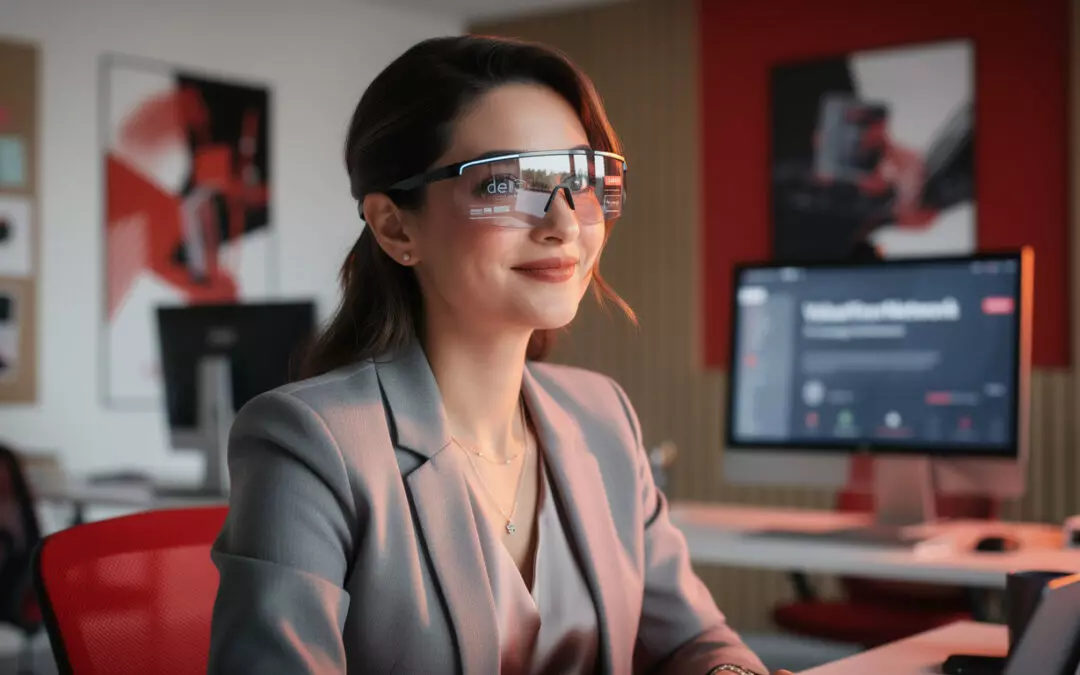
Meta AI glasses: Ray-Ban and Oakley models, prices, creator use cases, limitations, and concrete benchmarks for choosing this accessory in 2026.
Owning Meta’s AI glasses is no longer a far-off prospect reserved for trade show demos. With the Ray-Ban Meta Display, the next-generation Ray-Ban Meta, and the Oakley Meta Vanguard, Meta is moving toward everyday use of artificial intelligence worn on the face.
The topic deserves a practical look. Price, availability in France, video features, voice assistant, translation, real-time captions, control wristband: every detail changes the way content is created, an audience is engaged with, and a scene is captured without taking out a smartphone.
Owning Meta’s AI glasses in 2026: what changes in everyday use
Meta’s AI glasses are becoming more interesting because they fit into a gesture people already know: wearing glasses. The difference lies in the integration of a display, a camera, microphones, open-ear speakers, and an AI assistant capable of interpreting what the user sees. The Ray-Ban Meta Display, unveiled at Meta Connect in Menlo Park, can, for example, show messages, photos, videos, video calls, and AI-generated directions in the right lens.
In practical terms, this evolution reduces the time spent handling a phone. A creator can film a tasting, check a notification, or follow captions without breaking their interaction with the person in front of them. This visual continuity matters a lot in short-form content, where perceived authenticity often depends on how smoothly everything flows.
One plausible example illustrates this well. During a boutique launch in Lyon, a lifestyle creator films guests arriving with her glasses, asks the assistant to remember the names of the products being presented, then later pulls the clips to edit three vertical videos. The phone stays in the bag. The content feels less staged, closer to the lived experience. For a brand, this kind of capture can create a more spontaneous narrative, provided consent rules are respected.
Meta is also betting on a more discreet interface. The display, camera, and certain controls activate by voice or with small finger movements thanks to a wrist-worn band. That detail is not trivial. It avoids turning every interaction into a visible manipulation and limits the gadget effect. The promise becomes more credible when the technology disappears behind the use case.
From experience, the most serious potential is not just in the camera. It comes from the combination of contextual vision, an AI assistant, and social sharing. See an ingredient, ask for a recipe idea, film the preparation, publish a short clip: the whole chain gets shorter. Can this still be called a simple accessory when it captures, analyzes, and supports creation in real time?
That said, the product will not suit every profile. People who are only looking for a stylish pair of glasses may find the technology too much. On the other hand, creators, mobile journalists, field consultants, sports coaches, and event teams may find a highly effective capture and assistance tool. Use will make the difference between an image-driven purchase and one that is truly productive.
To follow the previous developments in the line, the analysis of Ray-Ban Meta glasses already shows how Meta turned a fashion item into a connected creation tool. The version with a display continues that trajectory, with a more direct level of interaction.
Meta AI glasses, prices and models: Ray-Ban Display, Ray-Ban Meta and Oakley Vanguard
The Meta lineup becomes clearer in 2026 because it addresses three distinct needs. The Ray-Ban Meta Display targets advanced uses with an integrated display. The next-generation Ray-Ban Meta remain more affordable for photo, video, and audio capture. The Oakley Meta Vanguard are aimed at sports use, with a design built for intensity, movement, and hands-free operation.
The Ray-Ban Meta Display were announced at $799, or about €675 based on the exchange rates provided at the time of the presentation. Sales began in the United States, with expansion planned for France, Canada, Italy, and the United Kingdom early in the year. This timeline gives European brands a short window to prepare suitable activations.
The classic next-generation Ray-Ban Meta are priced starting at $379, or around €320. They do not play exactly the same role. Without an integrated display, they remain centered on capture, listening, voice commands, and the assistant. Their appeal lies in a lower price and a simpler user experience for the general public.
The Oakley Meta Vanguard, announced at $499, or about €420, introduce a sports angle. They can take hands-free photos and videos, use an AI assistant, and offer instant translation in the ears. For a runner, cyclist, coach, or outdoor creator, the value is measured in the field: less gear to handle, more continuity in the effort.
| Model | Positioning | Headline Features |
|---|---|---|
| Ray-Ban Meta Display | Advanced use with integrated display | Display in the right lens, video calls, subtitles, AI guidance, voice control, and wristband |
| Ray-Ban Meta Gen 2 | Everyday use and social creation | Photo, video, open audio, AI assistant, Ray-Ban design, more accessible price |
| Oakley Meta Vanguard | Sports and high-mobility use | Hands-free capture, instant translation, AI assistant, frame designed for action |
This breakdown avoids a common mistake: comparing all models as if they met the same need. An agency producing social content at events will focus primarily on the display and subtitles. A sports club or outdoor brand will instead evaluate stability, durability, and audio quality in noisy environments.
The partnership between Meta and EssilorLuxottica, launched in 2019, also provides an industrial advantage. Ray-Ban and Oakley are not neutral brands in the collective imagination. They bring fashion and sports credibility that Google Glass had not achieved in 2013. The failure of that first major attempt showed that technology worn on the face must first be socially acceptable.
The market confirms this momentum. According to Grand View Research, the global smart glasses market was valued at nearly $2 billion in 2024 and could reach $8.26 billion per year by the end of the decade. This figure does not guarantee the success of every model, but it points to a clear acceleration in demand.
The players following the battle for connected glasses therefore see a shift: the question is no longer simply whether the product exists, but which specific use case justifies buying it. The price becomes acceptable when the gain in time, content, or comfort can be measured quickly.
Creating content with Meta AI glasses: opportunities for influencers and brands
For creators, Meta AI glasses can change short-form content production. The built-in camera enables an immersive point of view without requiring a smartphone to sit between the creator and their surroundings. This approach works especially well for cooking, fashion, sports, travel, training, and brand events.
A beauty tutorial can show the exact gesture from the perspective of the person applying the product. An apartment tour can feel more natural because the narration follows the viewer’s gaze. A fitness coach can record a demonstration without a tripod or assistant. This type of content already exists with action cameras, but glasses add a more discreet social aspect and more direct AI interaction.
The announced features reinforce this use case. Meta says the AI can help prepare a recipe from filmed ingredients, amplify friends’ voices in a noisy environment, or provide real-time subtitles for a speaker on the display glasses. These features address specific pain points: lack of attention, noise, language barriers, and interruptions in flow during recording.
- For food influencers: film a cooking process from a first-person point of view while asking for a recipe suggestion.
- For event creators: capture behind-the-scenes moments without interrupting a conversation with a guest.
- For sports coaches: record an exercise in motion and comment on the action live.
- For retail brands: document a customer journey, a product demonstration, or an in-store activation.
Nuance is still necessary. Content shot with glasses can lose quality if it lacks framing, lighting, or editorial intent. The first-person perspective is attention-grabbing at first, but it quickly becomes tiring if the storytelling is not well structured. The best campaigns will not be those that use the device merely to look modern, but those that integrate it into a clear creative approach.
At ValueYourNetwork, observing social campaigns shows that technical novelty performs best when it serves a simple idea. A creator filming an in-store immersion must know what they want to prove: the speed of a service, the quality of advice, the emotion of a launch, access to behind-the-scenes moments rarely shown. Without that focus, technology becomes just a backdrop.
Data issues must also be part of the strategy. The glasses capture faces, voices, and private environments. The debates around facial recognition and Meta glasses show that social acceptability will depend on transparency. A brand will need to provide simple guidelines: inform participants, mark filming areas, and avoid sensitive captures.
Another point: the glasses do not replace a social media strategy. They add a format. Content will still need to be edited, titled, adapted to the platforms, and measured. Teams that connect this tool to the right metrics — retention rate, qualified comments, clicks, saves, conversions — will gain a stronger lead than those that simply publish a spectacular video.
To frame these uses, trends related to social networks in 2026 provide a useful benchmark: the best-performing formats combine usefulness, closeness, and visual proof. Meta’s AI glasses can strengthen these three dimensions, as long as immersion is not confused with constant improvisation.
The limitations to anticipate before buying Meta AI glasses
An innovative accessory only becomes relevant if its constraints are identified before purchase. Meta AI glasses raise several practical questions: battery life, comfort, data protection, compatibility with vision correction, public use, and dependence on the Meta ecosystem. These points do not cancel out the product’s appeal, but they should guide the decision.
The first limitation concerns acceptance by people around you. A pair of glasses equipped with a camera can make others uncomfortable, even if the user is acting in good faith. In a restaurant, gym, or business meeting, recording must remain explicit. The best reflex is to say out loud what’s happening: “these glasses are filming this demo, is everyone okay with that?” This simple sentence prevents many misunderstandings.
The second limitation involves cognitive load. Receiving messages, directions, or captions in your field of view can help, but it can also distract. Creators will need to learn to strike the right balance. A useful display during an interview can become intrusive during an emotional scene or a negotiation. The tool must remain in service of attention, not the other way around.
The price also deserves a cold-eyed look. At $799 for the Ray-Ban Meta Display, the purchase makes more sense for a content professional or a marketing team than for occasional use. The $379 or $499 models may be more suitable if the screen is not necessary. The right choice therefore depends on the most common scenario, not the most impressive spec sheet.
Vision correction is another factor. Meta says some frames can be customized with prescription lenses. For glasses wearers, that detail changes everything. An accessory worn all day must meet a real optical need. Readers interested can consult the analysis on the Meta Ray-Ban glasses with prescription lenses in order to assess the practical implications.
Brands must also finally prepare an internal usage framework. Who is filming? Where is the content stored? Which shots are deleted? Which rights are requested from visible people? These questions may seem administrative, but they protect the relationship with the audience. A successful campaign depends not only on a good idea; it also depends on disciplined execution.
ValueYourNetwork has been supporting brands with these trade-offs since 2016 with deep expertise in influencer marketing. The agency has led hundreds of successful campaigns on social media, with creators of varied profiles and measurable objectives. Its strength lies in its ability to connect influencers and brands according to the right context, the right format, and the right level of rigor. To prepare an activation around Meta AI glasses, structure a creative setup, or select the most relevant profiles, contact us.
Ultimately, the purchase should start with a primary use case. Immersive capture, sports, translation, subtitles, product demos, enhanced customer service: each scenario leads to a different choice. Meta AI glasses are appealing for their promise, but their value is measured above all in the repetition of useful gestures.
Frequently asked questions about Meta AI glasses
Are Meta's AI glasses available in France?
Yes, Meta's AI glasses are arriving in France with gradual availability depending on the models. The Ray-Ban Meta Display were first launched in the United States before an announced expansion to several European markets.
What is the price of Meta's AI glasses?
The price varies by model. Meta Ray-Ban Display AI glasses are priced at $799, while Ray-Ban Meta start at $379 and Oakley Meta Vanguard at $499.
Can Meta's AI glasses record without a phone?
Yes, Meta's AI glasses can record without holding a smartphone. They allow hands-free capture, which is useful for creators, athletes, and events.
Do Meta's AI glasses display messages in the lens?
Yes, some models allow it. Meta Ray-Ban Display AI glasses integrate a display into the right lens to show messages, images, video calls, and AI directions.
Do Meta’s AI glasses work with prescription lenses?
Yes, some models are compatible with vision correction. Meta AI glasses can be fitted according to the options offered by optical partners.
Are Meta's AI glasses useful for influencers?
Yes, they can. Meta AI glasses make POV videos, behind-the-scenes content, product demos, and more spontaneous short-form content easier.
Do Meta's AI glasses translate conversations?
Yes, certain translation functions are planned. Meta's AI glasses can provide instant translation in the ears depending on the languages and services available.
Do Meta's AI glasses raise privacy questions?
Yes, privacy needs to be anticipated. Meta's AI glasses can capture images, voices, and surroundings, which requires consent and transparency.
Do Meta's AI glasses replace an action camera?
Not always. Meta’s AI glasses offer more social and discreet capture, but an action camera is sometimes better for extreme conditions.
Should a brand buy Meta’s AI glasses?
Yes, if the use is clear. Meta’s AI glasses can support an influencer campaign, an event, or a product demo if the editorial framework is clearly defined.
Are Meta AI glasses suitable for professional use?
Yes, Meta AI glasses can be suitable for professional use when the needs are specific: content creation, product demos, events, sports, or field training. Their value depends mainly on the use case and the capture setup.
Can Meta AI glasses help an influencer campaign?
Yes, Meta AI glasses can enhance an influencer campaign by providing an immersive view, more natural behind-the-scenes footage, and more spontaneous short-form content. Performance, however, depends on the creative concept, the choice of influencers, and the metrics being tracked.
Which Meta AI glasses model should I choose for sports?
The Oakley Meta Vanguard are the best suited for sports. These Meta AI glasses are designed for motion-based use with hands-free capture, AI assistant, and audio translation, making them relevant for outdoor creators and coaches.
Are Meta AI glasses a good buy for a beginner creator?
Yes, but not in every case. Meta AI glasses can help a beginner creator produce immersive content, but a well-used smartphone remains sufficient if the editorial direction, editing, and consistency are not yet under control.