
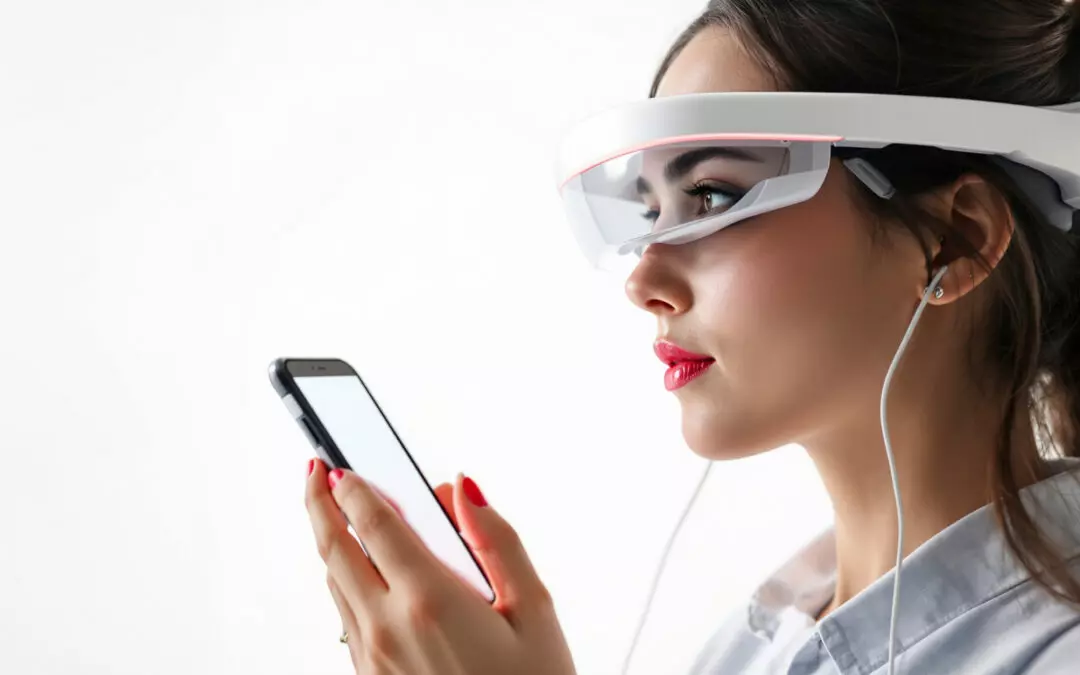
The Phoenix VR headset appears for the first time in clear images taken from official software from Meta. They show a slim mixed reality device, equipped with nose supports, several sensors, and a cable coming out of the left arm. However, Meta had confirmed neither its commercial name, nor its features, nor its price, nor its release date as of September 18, 2026.
The first clear images of the Phoenix VR headset
On September 10, 2026, several specialized media outlets, including UploadVR, Road to VR, TechRadar, and Android Authority, documented the discovery of images in the software package “HorizonOS Prescription Lens.” Meta had published this component for free in August 2026 before updating it in September.
So this is not a stolen photograph taken in a factory. The visuals come from a software environment distributed by Meta and show how to install prescription lenses. This origin gives them more weight than an anonymous rendering shared on a social network, without however constituting a commercial announcement.
An internet user who identified the package mentions version 1.0.0.0.3139 and build identifiers 1289258314272342 and 1063511592. This detail still comes from a single source. It should be treated as a reported technical element, not as information officially commented on by Meta.
Blurrier renderings, associated with the label “PHX,” had already been spotted in July 2026 in eye-tracking configuration resources. However, the September update provides the first representation clear enough to examine the general shape of the Phoenix VR headset.
A design closer to glasses than to a Quest
The images show a thin frame, with side arms and nose supports. Visually, the Phoenix VR headset therefore moves away from the front-heavy form factor characteristic of the Quest 3 and Quest 3S, the only two headsets currently shown in Meta’s official device comparison tool.
Several sensors are visible on the sides and under the frame. Their exact function is not confirmed, but their orientation appears consistent with observing the environment, hands, or gaze. Stating their resolution, field of view, or technology would be premature.
A cable comes out of the left arm. According to UploadVR, Phoenix is said to be designed as an ultralight premium device, with an open periphery, connected to an external compute unit. That is plausible in light of the cable and the displayed thinness, but Meta has not publicly confirmed either the unit or the internal architecture.
This choice would address a well-known constraint in mixed reality: moving part of the computing and the battery allows what you wear on your face to be lighter. The trade-off is immediate. A cable and a separate module can hinder mobile demonstrations, outdoor creation, and highly choreographed brand activations.
What is confirmed, visible, or only reported
The confusion between visual evidence and a spec sheet is already fueling overly assertive publications. For the Phoenix VR headset, the right method is to separate the visible elements, the information reported by the press, and the unknowns.
| Element | Status as of September 18, 2026 | What can be stated |
|---|---|---|
| Images of the device | Documented by several media outlets | They come from the HorizonOS Prescription Lens package updated in September 2026 |
| Phoenix name | Reported code name | Phoenix is not a commercial name confirmed by Meta |
| Shape and sensors | Visible | Thin frame, nose pads, side and bottom sensors, cable on the left |
| Prescription lenses | Visible in the software | The walkthrough shows their attachment and the scanning of a QR code, with the Zenni Optical brand |
| Eye and hand interaction | Reported | UploadVR presents it as the envisioned main interface |
| Price and full specifications | Unknown | No reliable public data |
| Release in the first half of 2027 | Reported, unconfirmed | An internal memo cited in December 2025 reportedly pushed the project back from 2026 to 2027 |
The names “Phoenix,” “Loma,” and “Stanley” remain reported development codenames. The classic pitfall is to turn them into definitive commercial product lines. Meta may change the name, modify the product, or abandon a configuration before its unveiling.
Prescription lenses and eye tracking: the strongest clues
The software shows the installation of prescription inserts as well as the scanning of a QR code. The Zenni Optical logo appears in these resources. This integration suggests that use by people who wear glasses is being considered from the configuration flow onward, which matters much more in daily use than a theoretical difference in power.
UploadVR also found references to “Eye Unlock” in August 2026. This eye-based authentication feature would be intended for unlocking, purchases, and certain protected operations. Here again, this is a feature identified in firmware, not a public commitment regarding the final product.
Honestly, an interface mainly driven by gaze and hands will only work if it remains reliable under imperfect conditions: changing lighting, partially obscured gestures, makeup, prescription glasses, or filming while moving. A controlled demo makes an impression quickly. Repeated use, however, reveals every point of friction.
This direction brings Phoenix closer to a broader strategy in which Meta is seeking to make wearable computing less dependent on controllers. The opening of Meta Ray-Ban Display glasses to third-party apps and the evolution of Meta AI Core and Meta AI Premium show that hardware, artificial intelligence and the software ecosystem are now designed together.
What creators and brands need to prepare
The Phoenix VR headset is not yet a platform to include in a firm media plan. It is, however, a useful signal: Meta is working on lighter and potentially more social mixed reality, in which gaze, hands, and the physical context would replace part of touch-based interactions.
For creators, the mistake would be to wait for the release to learn how to tell a spatial experience. Traditional vertical formats do not properly show what the user sees. You need to plan for external capture, a first-person view, and a narrative that remains understandable even without wearing the headset.
- Prepare a 20- to 40-second demo centered on a single use case, rather than a catalog of features.
- Film the real gesture and the perceived result simultaneously to avoid a video made up only of captures that are difficult to read.
- Add descriptive subtitles: the audience must understand where the user is looking and what they are selecting.
- Clearly separate tested features from features that have been announced or reported.
- Negotiate specific reuse rights if a brand wants to use the demo in advertising.
Advertisers should also avoid setting compensation based solely on follower count. A mixed reality demo often requires more preparation, editing, and explanation than a standard product placement. The benchmarks presented in our guide on influencer compensation must then be supplemented by production costs, media rights, and possible technological exclusivity.
In this niche, it is better to select five creators capable of clearly explaining a use case than fifty profiles posting the same unboxing. Completion rate, saves, qualified comments, and clicks to a waiting page will be more useful than raw views. Technological curiosity easily attracts a broad audience, but not necessarily one that will buy.
Why Meta is still keeping so many unknowns
As of September 18, 2026, Meta’s official comparison page lists only the Quest 3 and Quest 3S. No product named Phoenix has been announced. No reliable price, no complete technical specifications, and no final date are public.
An internal memo cited by Business Insider, then relayed in December 2025, reportedly shifted the planned launch from 2026 to the first half of 2027. This timeline was never confirmed by Meta. Weight, battery life, heat dissipation, and production constraints could still lead to significant changes.
For a community manager, the right editorial angle is therefore not “here is Meta’s next headset,” but “here is what Meta’s resources show and what remains to be confirmed.” This nuance protects the credibility of both a media outlet and a creator. It also prevents outdated content from lingering for months with an incorrect price or name.
ValueYourNetwork supports social strategies based on practical use cases rather than the noise of a leak. Whether you are influencer or an advertiser, grow your social networks with our expertise and contact us to prepare campaigns tailored to new formats.
FAQ about Meta’s Phoenix VR headset
Has the Phoenix VR headset been announced by Meta?
No. As of September 18, 2026, Phoenix remains a reported codename. Meta has confirmed neither the product nor its commercial name.
When will the Phoenix VR headset be released?
No official date is available. An internal memo cited by the press reportedly mentioned the first half of 2027, but Meta has not confirmed this timeline.
What will the price of Meta’s Phoenix headset be?
No reliable price has been published. Estimates circulated without an announcement from Meta should not be presented as actual pricing.
Will the Phoenix headset work without controllers?
UploadVR reports interaction based primarily on eye and hand tracking. The final control methods and the possible presence of accessories remain unknown.
Will the headset be compatible with prescription lenses?
Images of the HorizonOS Prescription Lens package show prescription inserts, a pairing QR code, and the Zenni Optical brand. The commercial details have not been announced.