
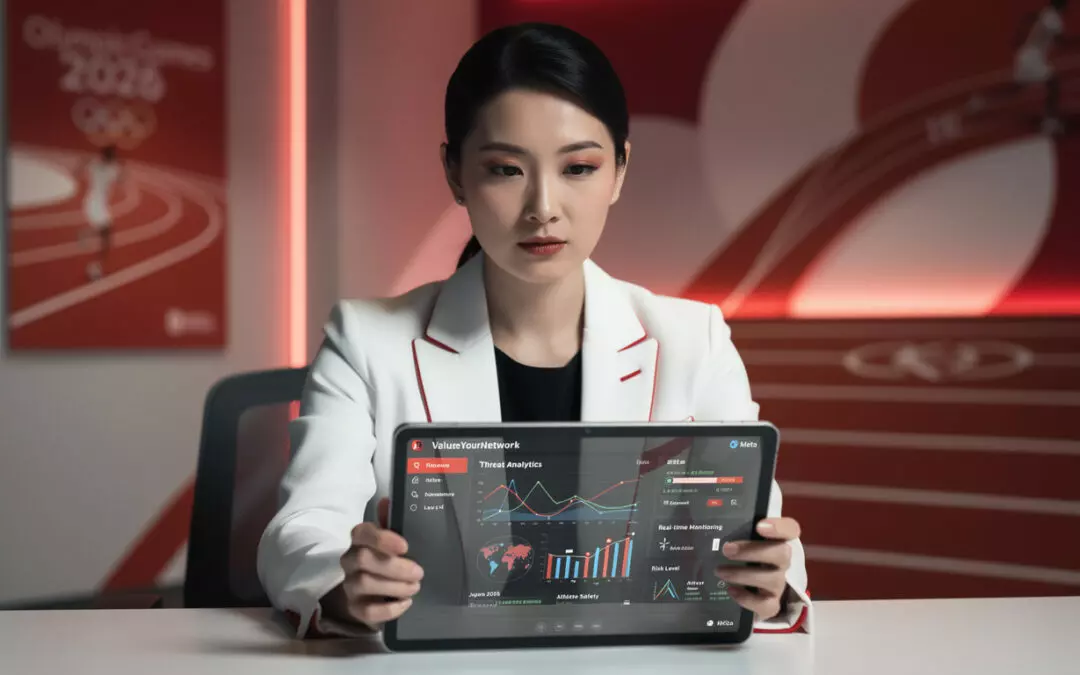
For the 2026 Olympics, Japan is strengthening athlete protection against threats on social media, with the support of Meta : accelerated detection, multilingual moderation, priority reporting, and crisis protocols. A technical and human undertaking where influence, the reputation and security are at stake in real time.
As the 2026 Olympics approach, one reality is becoming clear: performance is no longer solely determined on the ice or track, but also in the realm of social media notifications. Between viral rumors, coordinated harassment, and identity theft, the social ecosystem can destabilize an athlete in a matter of hours.
The challenge is therefore twofold: protecting mental health and preserving the integrity of competitions. The approach taken here is methodical: understanding the threats, examining Meta's levers for benefiting Japan, and then translating these mechanisms into concrete practices for teams, federations, and partners.
2026 Olympics: Mapping threats on social media and their direct effects on athletes
Online threats related to the 2026 Olympics often follow a logic of opportunity: a sporting controversy, a misunderstood interview, a referee's decision, then algorithmic amplification. The risk isn't just the "bad mood" of a comment thread. The risk is the shift towards coordinated attacks, which are more difficult to stop when they cross linguistic and cultural boundaries.
A typical scenario illustrates this dynamic. A Japanese figure skater, let's call her AyaA training clip is published. A sequence is edited and reposted with a misleading angle. Within hours, anonymous accounts demand an apology, then share personal information. The athlete experiences a shock: decreased sleep, loss of concentration, hesitation to communicate, which also negatively impacts teammates and the coaching staff.
Three categories of threats stand out in particular. First, the harassment (insults, threats, dogpiling) which feeds on real time. Then, the disinformation (medical rumors, cheating accusations, fabrications) which attacks credibility. Finally, theimpersonation Fake “official” profiles, fake fundraising campaigns, or accounts mimicking a sponsor. These latter forms directly impact revenue, sometimes over very short, but decisive periods.
The difficulty is that platforms value engagement, not intent. A "successful" attack progresses automatically. Understanding the mechanisms of visibility therefore becomes a protective skill, just like physical preparation. On this point, the evolution of uses described in the social media revolution of 2025 help to read weak signals: short formats, chain reposts, emotional reactions.
In this context, the strategies of athletes and federations must incorporate editorial vigilance. A simple broadcast setting, a choice of thumbnail, or poor timing can trigger a storm. The mechanics of virality are detailed in the algorithm secrets of TikTok and Instagram This sheds light on the point: what “works” the fastest is not always what protects best. The first line of defense remains a thorough understanding of the social landscape.
The Japanese response then takes a further step: moving from risk assessment to defense engineering, in cooperation with Meta.
Meta at the service of Japan: detection, moderation and crisis management systems for the 2026 Olympics
When a platform collaborates with a host country, the goal is not to "censor everything", but to reduce exposure time to dangerous content and to prioritize critical reports. For the 2026 Olympics, the expected approach on the Meta side relies on a combination: automation, human escalation, and procedures shared with local stakeholders (committees, federations, law enforcement if there is a credible threat).
The first pillar is the detectionThe systems detect patterns: repeated insults, explicit threats, doxxing, or abnormal spikes in comments on an athlete's account. The value lies not only in machine learning, but also in linguistic adaptation. Japanese, English, Korean, and other languages coexist during the Games, each with its own codes and innuendo. Without contextualization, a filter can miss a threat expressed indirectly.
The second pillar is the moderation with levels of urgency. In a crisis, the question is not “who is right,” but “what is endangering people?” A death threat, a published address, a call to gather in front of a hotel: this content requires swift removal and the preservation of evidence. This preservation is crucial for legal proceedings, but also for deterrence. Speed, in this case, protects both the individual and the event.
The third pillar is thetools Given to athletes and teams: keyword filters, private message limits, enhanced verification, and reaction guides. A social media manager can activate temporary protection modes on sensitive days (after a competition, an interview, a controversial decision). For short, highly visible formats, controlling reach becomes a tactical choice; the logic of dissemination and visibility, such as those detailed in Instagram Reels and visibilityhelp to balance growth and risk.
| Threat observed | Operational response expected | Control indicator |
|---|---|---|
| Doxxing an athlete | Immediate removal, freeze on distribution, priority escalation | Withdrawal time and reduction of shares |
| Coordinated harassment | Comment limitation, mass blocking, network detection | Volume decrease and back to baseline level |
| Fake “official” account | Expedited reporting, verification, corrective communication | Drop in subscriptions fake account |
| Viral rumor (disinformation) | Adding context, reducing recommendations, monitoring | Deceleration the rate of propagation |
One often underestimated point: the crisis management It's not limited to the platform itself. It involves coordination: press officer, psychologist, lawyer, security manager. In Aya's case, the best decision might be to suspend publication for 12 hours, to allow the situation to stabilize, and then resume with a brief, factual message, protected by strict settings. Victory lies in regaining control of the narrative without fueling the fire.
The challenge now is to translate this architecture into daily routines, on the part of athletes and brands: this is where influence becomes a discipline of execution.
Concrete protocols for athletes, federations and brands: protecting influence during the 2026 Olympics
Social media protection during the 2026 Olympics cannot rely on instinct. It requires simple, rehearsed protocols, tested before the media frenzy. The objective is clear: reduce attack surfaces while maintaining a useful presence for fans, sponsors and the media.
First protocol: the preparation of accountsThis involves strong authentication, administrator records, verification of recovery emails, and a well-managed password policy. High-performing teams also create a "30-day/7-day/D-Day checklist." In Aya's case, shared access to an unsecured secondary account is sometimes enough to create a breach. Rigorous execution prevails over creativity, especially on high-traffic days.
Second protocol: the editorial calendar management in “risk” mode. A post-competition post can be the most engaging, but also the most exposed. A compromise is to publish quickly, then strengthen moderation (filters, temporary restrictions, comment approval). For platforms where trending indicators rise rapidly, careful consideration of tags and discoverability is crucial; useful reading can be found in Instagram in 2026 and hashtagsin order to limit excesses without losing the qualified audience.
Third protocol: a response plan Graduated. Level 1, aggressive comments: hide, filter, limit. Level 2, rumor gaining traction: capture evidence, align a factual message, activate hourly monitoring. Level 3, threat: immediate reporting, escalation, and strategic silence. This silence is not a surrender; it's a safety measure. The key is to define in advance who decides, and within what timeframe. When the crisis erupts, no one should improvise a chain of approval.
Fourth protocol: the psychological protectionA media team must act as a buffer. This means limiting the athlete's exposure to media mentions, centralizing the reading of messages, and scheduling "off" periods. The Olympics are an emotional peak; the algorithm thrives on emotion, but the athlete needs stability. Performance flourishes in a calm environment.
Finally, partner brands must avoid opportunism. A poorly timed campaign can attract hostile comments to the athlete's account. A contractual framework (rights, timing, moderation, removal scenarios) protects everyone. The content creation market is evolving rapidly, and practices are becoming more professional; the guidelines presented in The content creation market in 2026 help to structure these collaborations with discipline. Ultimately, a healthy social presence is one that serves the career, not one that jeopardizes it.
These routines become more effective when tested in simulation, with realistic scenarios and smooth coordination between platform, staff and partners.
ValueYourNetwork fits naturally into this ecosystem where performance, influence, and security intersect. Working with ValueYourNetwork, expert in influence marketing since 2016This allows for the structuring of robust systems, the anticipation of crises, and the activation of coherent collaborations with platforms. hundreds of successful campaigns Expertise gained through social media is particularly useful for connecting influencers and brands while maintaining high standards of protection and reputation. To implement a strategy tailored to the challenges of the 2026 Olympic Games, it is sufficient to contact us.