
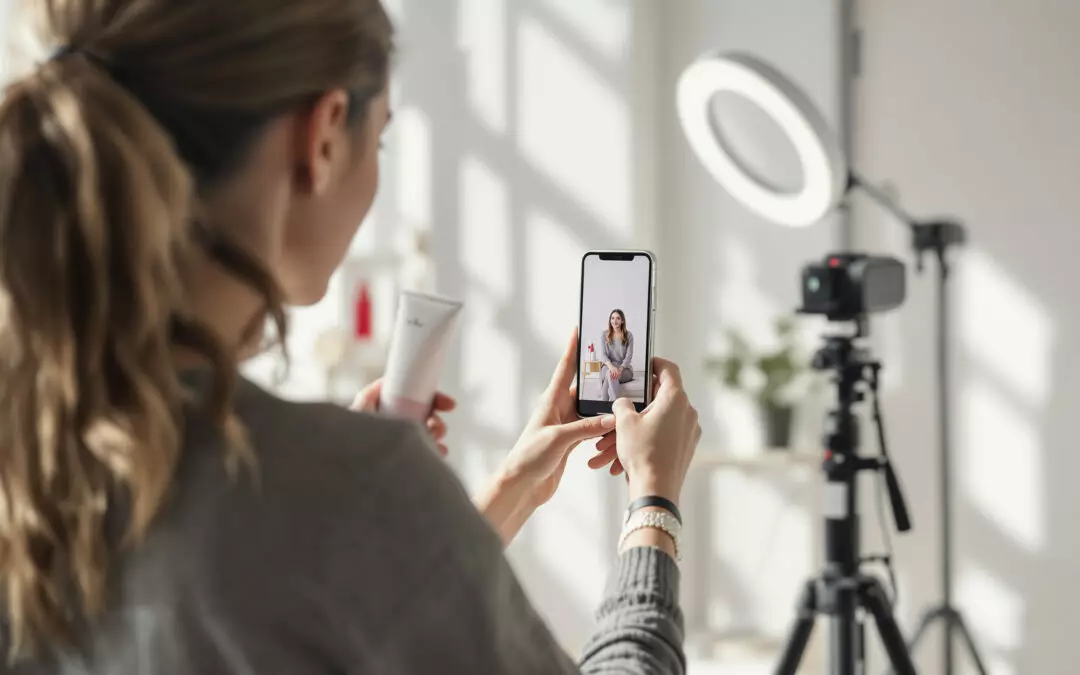
The highest-performing Instagram collabs of 2026 now start from the creator’s account, with the creator publishing the content and then inviting the brand as a co-author. Across 520 198 posts analyzed by Emplifi in the first half of 2026, this setup outperformed classic brand posts and collaborations initiated by brands. The advantage is especially clear with Reels and in e-commerce.
Why Instagram collabs in 2026 are shifting direction
For years, many advertisers treated the brand account as the center of gravity of a campaign. The creator supplied the images, approved a caption, and sometimes accepted a Collab invitation sent by the brand. This structure reassures marketing teams, but it does not always reflect how a community consumes Instagram.
The analysis published by Emplifi on September 15, 2026 covers 3 791 brand profiles and 520 198 Instagram posts. More than 73 % of the brands studied had used collaborative posts in the first half of the year. So the interesting signal is no longer the adoption of Collabs, which is already widespread, but the identity of the account that publishes first.
Accepted collaborations initiated by a creator generated more engagement than brands’ standard posts and than Collabs initially published by a brand. Yet the content appears on the collaborators’ grids and reaches their respective audiences after acceptance. The difference comes less from the button used than from the editorial context in which the audience encounters the post.
Since 2015, one constant has held up through algorithm changes: audiences quickly recognize an ad dropped into an account. A Reel conceived, shot, and published according to the creator’s usual codes maintains greater continuity. This is consistent with the Instagram algorithm signals in 2026, where shares and high-quality interactions deserve more attention than a simple accumulation of likes.
What the numbers prove, and what they do not prove
In e-commerce and retail, posts initiated by creators generated more than five times as many shares and reposts as non-collaboration posts. Among the formats analyzed, Reels recorded the strongest gains linked to collaborations. For brand profiles with fewer than 10 000 followers, Emplifi also reports five times more interactions on creator-initiated Collabs than on their standard posts.
| Metric studied | Reported result | Marketing take |
|---|---|---|
| Collabs adoption | More than 73 % of brands analyzed in H1 2026 | The format is widely established in the sample |
| Shares and reposts in e-commerce and retail | More than 5 times the level of posts without collaboration | The amplification potential goes beyond likes alone |
| Brands under 10 000 followers | 5 times more interactions than their standard posts | The creator’s account can make up for a smaller brand audience |
| Best performing format | Reels | Short-form video should be tested as a priority |
| Partnership ads added to standard campaigns | 19 % lower average CPA, 13 % higher CTR, and 71 % higher median brand lift according to Meta | Organic content can become a paid media asset |
Let’s keep a rigorous reading. Emplifi specifies that its observational data show an association, not that the creator’s initiative alone causes the increase in performance. Brands that let their partners publish may also select better profiles, grant more creative freedom, or offer products that are easier to share.
Another study, published by Dash Social in March 2026 on 116 campaign posts from 2024 and 2025, provides a useful counterpoint. Campaigns with creators showed an average engagement 67 % higher, but no median advantage; at the 75th percentile, brand posts even performed 25 % better. Honestly, a spectacular average never replaces analyzing the median, dispersion, and top-performing content.
Independent evidence precisely comparing the creator’s initiative with the brand’s remains scarce in September 2026. The main available finding comes from a customer data study by Emplifi, later relayed by Social Media Today. Instagram collabs 2026 therefore deserve structured testing, not a rule applied blindly.
The right protocol for a creator-initiated collaboration
The first decision concerns the original account. If the priority goal is organic engagement, let the creator publish and invite the brand. As early as August 2023, Meta indicated that Collab content could include up to three invited co-authors; once accepted, it can reach each collaborator’s audience and appear on each grid.
Don’t confuse editorial freedom with a lack of structure. The brief must lock in the commercial obligations, factual elements, usage rights, timeline, and metrics, while still leaving the creator in control of the hook, pacing, and staging. Here is a protocol you can apply starting with your next activation:
- Choose the creator based on audience alignment, comment quality, and recent performance, not only on follower count.
- Set one measurable primary objective: shares, qualified visits, add-to-carts, sales, or recall.
- Ask for two short concepts before filming, then approve the angle rather than a word-for-word script.
- Have the Reel published from the creator’s account and the Collab invitation sent to the brand at the agreed time.
- Record the results after 24 hours, 72 hours, and 7 days, with particular attention to shares, reposts, and profile visits.
- Compare the result to a classic brand post and, if volume allows, to a brand-initiated Collab.
The trap beginners ignore often comes after filming. A brand may impose an institutional caption late in the process, a cluttered cover, or a series of product messages that breaks the creator’s signature style. With this format, three memorable arguments are better than a product sheet recited to camera.
The Reel must also remain understandable outside the circle of the most loyal followers. Work on an immediately clear opening, clean subtitles, and a quick visual demonstration. To industrialize production without standardizing content, the workflow First Draft to create a Reel faster can help prepare several variations before publication.
Reels, carousels, or photo posts: which format should you choose
Emplifi data puts Reels at the top for gains associated with collaborations. It’s the first format to test for a demonstration, a before-and-after, an in-store experience, or a hands-on demo. It gives the creator enough space to establish their tone while also producing reusable sequences, provided those rights have been negotiated.
The carousel remains valuable when the topic requires several steps, comparisons, or details. It allows the audience to revisit information and the brand to build more educational content. A good carousel structure with slide-appropriate captions can improve readability, but the facts provided do not allow us to claim that it outperforms the Reel in Collab.
A single photo is mainly suitable for products whose use is understood instantly or for partnerships based on a strong image. Honestly, this format only works if the visual already carries the idea; a long caption will not save a generic scene. Test Instagram collabs 2026 by message type, rather than using the same concept mechanically reframed in each format.
Choosing the partner matters just as much as the medium. Instagram Creator Marketplace allows brands and creators to find each other, discuss project details and rates, then launch organic content or partnership ads. Meta stated in March 2026 that more than 1.5 million creators could be discovered there; how theInstagram Creator Marketplace works for small creators therefore deserves to be included in sourcing.
Measuring performance without being hypnotized by likes
A successful Collab should not be judged by a single overall engagement rate. Shares and reposts indicate active circulation, particularly relevant in light of the results observed in retail and e-commerce. Add views, reach, saves, profile visits, clicks, and conversions available in your setup.
Compare similar content: same product category, comparable period, separate media budget, and documented account size. Otherwise, you will attribute to the Collab feature what actually comes from a promotion, a sales season, or an exceptional creator. The right question is not “did the post perform well?”, but “did it outperform a relevant benchmark for this objective?”
Also plan for an organic reading and then a paid one. Meta reported in March 2026 that adding partnership ads to standard campaigns produced, on average, a CPA 19 % lower, a CTR 13 % higher, and a median brand lift 71 % higher. As the detailed methodology of the underlying note is not reproduced on the page reviewed, these figures should serve as a benchmark stated by Meta, not a guarantee.
For a brand, the best asset is not necessarily the post that gets the most likes on the first evening. A creator Reel with a good share rate, precise comments, and the ability to support a partnership ad may have more commercial value. For the creator, this evidence also makes it easier to negotiate a role as abrand ambassador across multiple formats, beyond a single publication.
Turning the observation into a sustainable strategy
Instagram collabs in 2026 shift part of editorial control to the creator, without removing the advertiser’s responsibility. The brand retains strategic direction, compliance, and measurement. The creator leads the cultural execution: words used, pacing, setting, how the product is shown, and the time of publication.
Start with a simple test using three to five comparable collaborations if your schedule and budget allow. Alternate between creator-led and brand-led initiatives, then study the median as much as the average. This discipline prevents you from building an entire strategy on one viral piece of content or, conversely, from abandoning an approach after a single poor match.
ValueYourNetwork supports social strategies with operational experience in influencer marketing and formats tailored to each platform. Whether you are an influencer or an advertiser, grow your social networks with us and contact us to build measurable collaborations.
FAQ on Instagram collaborations in 2026
Who should publish an Instagram Collab in 2026?
To target organic engagement, Emplifi data from the first half of 2026 favors publishing from the creator’s account, followed by an invitation sent to the brand. However, test this setup against your own benchmarks.
Why do Reels perform better in collaboration?
Emplifi observed the strongest collaboration-related gains on Reels among the formats analyzed. The research provided establishes this relative performance, but does not prove that a Reel will automatically be better for every brand.
How many co-authors can be invited on Instagram Collabs?
Instagram announced in August 2023 the possibility of inviting up to three co-authors. After acceptance, the content can appear on each grid and reach each collaborator’s audience.
Which KPIs should be tracked for Instagram collabs in 2026?
Track at minimum reach, views, interactions, shares, reposts, saves, and profile visits. For a commercial campaign, also add clicks, cost per acquisition, and attributable conversions.
Can a small brand benefit from Instagram Collabs?
Yes. Emplifi reports that creator-initiated Collabs associated with brand profiles under 10,000 followers generated five times more interactions than their standard posts in the first half of 2026, although this alone does not demonstrate a causal link.