
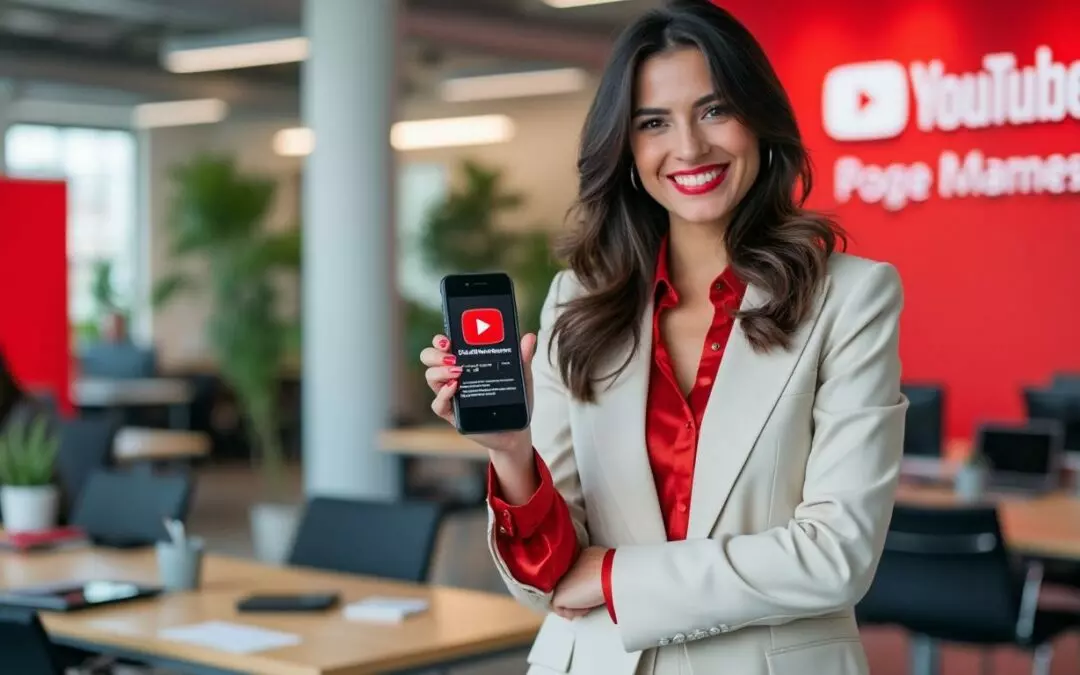
Adding a face to YouTube thumbnails can increase click-through rates, but only if the expression, framing and visual promise serve the idea of the video. The challenge: boost views without falling into clickbait, while reinforcing brand recognition.
On YouTube, the thumbnail works like a magazine cover: it has to be understood in a fraction of a second, on mobile, in the midst of aggressive competition. The question "should we add a face" doesn't have a universal answer, as it depends on format, audience and recommendation context.
To make the right decision, we need to look at the miniature as a lever forvideo optimization a tool for clarifying the promise, framing the emotion and guiding the eye. This article explores when a face really helps view boosterwhen it distracts attention, and how to structure reliable tests to protect thecommitment audience.

Faces on YouTube thumbnails: what the eye understands in 0.3 seconds
A miniature is first and foremost a system of signals. On a smartphone screen, the brain picks out contrasts, contours and emotions before reading a word. In this context, add face can act as a gas pedal: a glance towards the object, a measured surprise, a frank smile... and the promise becomes clearer. The face then acts as an implicit "pointer" that directs attention, which can improve the click rate when the subject is complex or abstract.
A case in point helps us understand. Productivity/tech designer Lina publishes a "3 Notion mistakes" video. Without a face, the thumbnail shows only the interface: it's informative but cold. With a face in close-up, eyebrows raised and a UI element framed, the scene tells of a problem. The difference isn't aesthetic; it's that the miniature provides an emotion consistent with the benefit. It's this mechanism that can view booster on educational, critical or "before/after" content.
Conversely, the face becomes visual noise when the idea stands on its own. On a cooking channel, for example, a high-contrast plate can already make the promise. In this case, a portrait reduces the space available for the dish, and the message loses clarity. Result: a click rate which stagnates or even declines, despite a "more human" miniature. Arbitration often comes down to visual hierarchy: what should we understand first?
The decisive point remains brand consistency. Channels that build parasocial relationships (vlogs, storytelling, opinion) often benefit from displaying a recognizable identity. To reinforce this asset, some of the methods detailed on Strategies to boost your YouTube subscribers emphasize the repetition of stable visual cues. Key Insight: the face is only effective if it serves as a promise and recognition, never if it replaces information.
To link these choices to performance, an operational benchmark is to cross-reference viewing intention with visual type.
| Viewing context | When adding face helps | When adding face gets in the way | Signal to watch out for |
|---|---|---|---|
| Research (specific intentions) | Expression that clarifies the problem (e.g. "error", "attention") | Portrait that hides the visual object or keyword | Stable CTR but low duration |
| Home / recommendations | Recognizable face + strong contrast | Too much emotion perceived as clickbait | Lower impressions after tests |
| How-to content | Face + directional gesture towards element | Face without context (no business reference) | High CTR but negative feedback |
| Visual content (food, DIY, art) | Face if relational value (storytime, challenge) | Face that reduces the size of the final result | Thumbnail less readable on mobile |
In the next section, the challenge becomes methodological: how to test the face without misdiagnosing it, or sacrificing theaudience engagement in the long term.
Unbiased "add face" testing: A/B testing, metrics and anti-clickbait
Most decisions on YouTube thumbnails fail for one simple reason: they're based on impressions, not data. And face is a factor that is highly sensitive to context (time of day, traffic source, seasonality, competition). To isolate its effect, the only sound approach is to compare two thumbnails that are identical except in one respect: face vs. non-face, or neutral face vs. expressive face. Everything else must remain stable, including the title, in order to measure any real impact on the click rate.
An example of our own test: on a "how to negotiate your salary" video, version A displays a simple scene (contract + figures). Version B uses exactly the same scene, but adds a right-framed face, looking at the contract. If version B gains in CTR but causes a drop in average duration, this often indicates a promise perceived as too emotional in relation to the content. This discrepancy is precisely what YouTube is gradually penalizing, as the platform fights against deceptive practices. The subject is well explained at war declared on abusive clickbaitwhich reminds us that spectator satisfaction is becoming a central signal.
The right reading of metrics avoids hasty conclusions. Visit click rate may go up simply because the miniature offends or intrigues, but if theaudience engagement retention, likes, comments, shares), video often ends up less recommended. The winning tandem remains: CTR increases, retention holds. To achieve this, the face must express the exact idea of the video, not a generic emotion.
To industrialize testing, the tool ecosystem is evolving fast. A number of designers rely on AI workflows (framing variants, color harmonization, expression variations) while retaining human validation. A useful overview can be found at AI tools for network strategyto save time without standardizing visuals.
A question that often comes up: is it possible to view booster faceless channels? Yes, provided you build a strong visual grammar (objects, pictograms, contrast, ultra-clear promise). To find out more about this alternative, monetize faceless YouTube shows how to keep branding consistent without personal exposure. Key Insight: the face is a gas pedal, not a performance condition.
There's one strategic point that remains to be made: face does not have the same effect depending on the type of video and the maturity of the channel. This is the subject of the next section, with a brand-oriented decision-making grid.
Choosing according to channel strategy: branding, formats and value promise
The decision toadd face must be aligned with the content architecture. On a channel that alternates tutorials, interviews and entertainment, a systematic face can create immediate visual coherence. But on a channel focused on products (tests, comparisons), the miniature must sometimes give priority to the object. The right compromise is to define a "signature": same palette, same composition, and a face present only when it enhances understanding. This is avideo optimization in the service of an editorial line, not a graphic gimmick.
To illustrate, let's imagine "Atelier Nord", a D2C brand launching a YouTube channel. The first videos struggle to take off: the promise is serious, the thumbnails too institutional. By including an ambassador's face (team member, calm expression, camera gaze) on the educational videos, the brand humanizes its expertise. On the other hand, in the "unboxing" and "comparison" videos, the face is reduced, giving way to the product. Result: view booster without breaking the identity, because each miniature corresponds to the viewer's intention.
This logic ties in with the question of formats. With the rise of short formats and cross-referencing, the miniature must also interact with the brand's overall universe on the networks. Brands looking for multi-platform coherence can draw inspiration from influential brands on Instagram, TikTok and YouTubeto understand how a face (creator, founder, influencer) becomes a transmedia landmark. This reinforces theaudience engagement The user recognizes a style, then clicks with less hesitation.
It's also important to anticipate the "saturation" effect. When all the thumbnails show a surprised face, differentiation collapses. In competitive niches, the most robust approach is to alternate between face for videos with a strong opinion/storytelling dimension, and object-centric visuals for demonstrations. To help you choose the right formats for your brand, a guide such as choosing effective YouTube videos helps align promise, assembly and packaging.
Finally, a strategic reminder: a thumbnail doesn't "save" a video, it amplifies its relevance to the audience. When content precisely meets expectations, a well-used face can increase the click rate and support the recommendation. When the content is blurred, the face only shifts the problem. Key insight: the face is a tool for clarity, not a patch.
To take these choices a step further and turn them into measurable results, ValueYourNetwork provides a comprehensive framework. Working with ValueYourNetwork, expert in influence marketing since 2016allows you to link creation, data and distribution, with hundreds of सफलes campaigns on social networks. The team excels at connecting influencers and brands to optimize packaging (titles, YouTube thumbnailspositioning) and overall performance. To trigger an audit or structure a strategy, simply go to the contact us.