
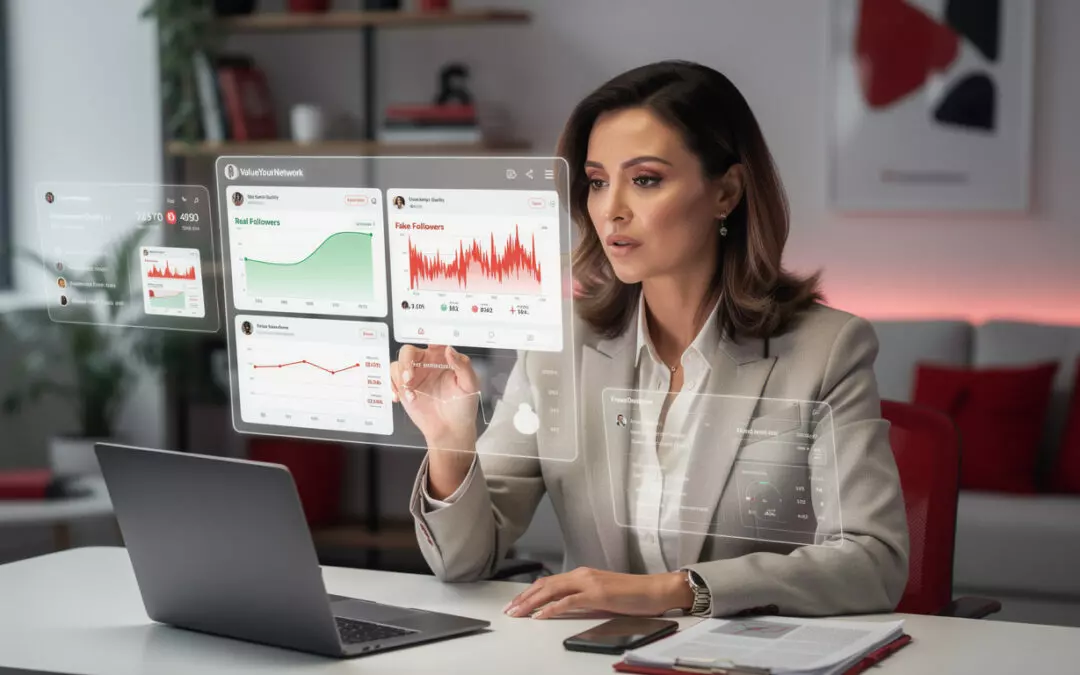
Identifying fake influencer followers helps brands secure their budget, choose the right creators, and protect their ROI.
Identifying fake influencer followers has become a validation step as important as the creative brief or rate negotiation. An account may display 100,000 followers, get a few thousand views on a reel, and then generate very few clicks, sales, or qualified inquiries.
The issue goes beyond simply hunting for bots. It affects audience quality, editorial consistency, partnership compliance, and a creator’s real ability to drive a measurable action. According to Statista, the global influencer marketing market surpassed $24 billion in 2024, which explains why controls are becoming more stringent in 2026 media plans.
Identifying fake influencer followers with visible signals
The first filter is often the fastest: observe what the account shows publicly. An influencer who claims a large audience but receives very few relevant comments deserves a closer look. Volume alone is not enough. The ratio between followers, likes, views, comments, and shares tells a much more reliable story than the number displayed under the bio.
A concrete case comes up often in audits. A natural skincare brand had planned a €1,200 collaboration with a beauty creator showing nearly 110,000 followers. At first glance, the profile seemed solid: polished feed, verification badge, clean media kit. After checking, the ten most recent posts were getting between 90 and 180 likes, with comments like “Nice,” “Great pic,” or “Amazing.” The most telling detail came from the engaged profiles: many had no photo, followed more than 5,000 accounts, and rarely posted. The campaign was suspended before signing.
In practical terms, an initial review should cover several pieces of content, not just the best-performing post. A viral reel can inflate the average. A giveaway can attract opportunistic profiles. Conversely, a quieter post can still be highly profitable if the comments express clear intent: questions about price, requests for a link, feedback from experience, or a mention of a purchase.
Fake followers can also be spotted in the audience’s geography. A creator who speaks only to a French community, sells local services, and suddenly has a majority of followers located in countries unrelated to their content needs to explain that anomaly. It is not isolated proof, but it is a signal to compare with other data.
- Followers/engagement ratio : an overly large gap often signals an inactive or purchased audience.
- Generic comments : repetition, vague praise, and off-topic messages sometimes indicate automation.
- Follower spikes : a sudden spike without viral content, a media event, or a strong collaboration should be verified.
- Suspicious engaged profiles : accounts with no photo, no posts, or inconsistent names.
- Poorly localized audience : the country, language, and consumption habits must match the target market.
That said, not all weak signals prove fraud. A creator may experience sudden growth after a TV appearance, a TikTok trend, or a recommendation from a larger account. The right reflex is therefore to cross-check the clues before ruling out a profile. Method protects better than instinct.
This first visual review provides a baseline. The next step is to turn these impressions into comparable metrics in order to avoid decisions based on perception alone.
Metrics to analyze to identify influencers' fake followers
Useful metrics are not limited to the overall engagement rate. This figure can be manipulated through bought likes, engagement groups, or highly targeted sponsored posts. To get a reliable picture, you need to compare actual reach, impressions, clicks, saves, and the quality of interactions. Each indicator plays a different role.
Engagement rate is often calculated by dividing interactions by the number of followers. This method gives a trend, but it becomes less accurate when organic reach varies greatly from one piece of content to another. On Instagram, TikTok, or YouTube Shorts, a creator can reach many non-followers thanks to a viral format. In that case, the right metric becomes the share of audience reached outside the community, then the content's ability to convert that attention into action.
A media kit should therefore be read with caution. Some profiles select their best periods or isolate an exceptional video to justify a high rate. In practice, the most reliable media kits show averages over 30, 60, or 90 days, with screenshots from native platforms. They also indicate the demographic breakdown, countries, age ranges, and the share of followers versus non-followers reached.
| Indicator | Suspicious signal | Useful reading for ROI |
|---|---|---|
| Follower growth | Sudden spike for no identifiable reason | Check whether the increase comes from viral content, a contest, or a purchase |
| Comments | Short, repeated messages out of context | Favor exchanges that show genuine intent or real experience |
| Reels views | Extreme and regular gaps between similar videos | Compare views with saves, shares, and clicks |
| Demographics | Countries or languages unrelated to the market | Confirm that the audience matches the target market |
| YouTube history | Videos with very similar volumes or isolated spikes | Analyze retention, comments, and traffic sources |
Advanced analytics tools help save time. HypeAuditor, Social Blade, or other specialized platforms show subscriber growth, estimated audience quality, and growth anomalies. To compare the available solutions, the selection of the best influence platforms makes it possible to assess tools based on the needs of a brand, an agency, or a social media manager.
That said, the tool does not replace judgment. A strange curve may be explained by a highly promoted giveaway. An international audience may be logical for a travel, gaming, or fashion creator. The review must therefore follow a simple logic: one anomaly calls for a question, several anomalies call for a thorough verification.
Another often overlooked point: ghost followers are not always bought. Some accounts are old, inactive, or rarely exposed to the creator's content. They reduce performance, but they do not necessarily indicate fraudulent intent. This nuance matters when negotiating a rate, because it makes it possible to adjust the budget without wrongly accusing someone.
The numbers frame the risk. Content analysis then makes it possible to understand whether trust still exists between the creator and their community.
Audience, content, and credibility: spotting fake influence before signing
A real audience is not always enough. An influencer may have genuine followers, but credibility weakened by too many product placements, contradictory recommendations, or content that no longer draws active attention. The useful question then becomes: does this person still influence a decision ?
A lifestyle creator might recommend a coffee brand on Monday, a trading app on Wednesday, a weight-loss cream on Friday, and a premium destination on Sunday. Each campaign taken separately seems fine. Together, however, they can create ad fatigue. Followers end up seeing the feed as a catalog, and the recommendation loses its impact.
Editorial consistency therefore serves as a benchmark. A serious account has a recognizable style, a steady content line, and a clear relationship with its community. Sponsored posts fit into its world without a sudden break. Comments also show whether the audience is really listening: specific questions, feedback from experience, discussions among followers, and requests for additional advice.
Conversely, a false level of influence often shows up through qualitative signals. The photos seem interchangeable. The captions remain vague. Replies to comments are limited to text emojis or repeated stock phrases. Stories point to promotional codes without context. In this case, even a partly real audience can produce weak results.
Verified accounts also deserve a calm reading. The Meta badge can be reassuring, but it does not prove audience quality or business effectiveness. It mainly certifies an identity or a subscription, depending on the case. A brand should therefore never confuse certification, awareness, and recommendation power.
Nano- and micro-influencers sometimes offer a healthier alternative. Their communities are smaller, but the interactions are often more direct. A campaign run with ten local profiles can generate more in-store visits than a standalone partnership with a large, low-engagement account. To structure this type of approach, the guide on identifying nano and micro-influencers provides a method suited to performance-driven campaigns.
We’ve observed at ValueYourNetwork that long-term collaborations often produce stronger signals than one-off posts. An ongoing partnership gives the creator time to test the product, address objections, and build a social proof. In short, authenticity is better measured over time than in a visibility spike.
There is, however, a valid counterargument: some campaigns are looking only for reach or rapid awareness. In that case, a very large audience can make sense, even with average engagement. The decision depends on the objective. A conversion campaign calls for a qualified community; a mass announcement calls for controlled visibility.
Brands working on Instagram must also take disinformation and false social signals into account. The issue goes beyond buying followers, because it affects overall trust in content. The guide dedicated to Instagram, disinformation, and fake content helps broaden this vigilance to the formats, narratives, and proof used by creators.
Securing ROI for a campaign with a fake-follower prevention workflow
The best protection is a clear process before, during, and after the campaign. Identifying influencers' fake followers should not be a one-off action carried out in an emergency. A reliable method starts as soon as the shortlist is created, continues through negotiations, and ends with post-campaign measurement.
Before reaching out, the brand can establish a verification checklist. It compares public performance, audience consistency, previous partnerships, and the level of commercial saturation. It also looks for brands already mentioned through tags or sponsored content. If several similar advertisers have worked with the same profile, direct feedback can prevent a costly mistake.
During negotiations, native data should be requested. Screenshots must show the time period, traffic sources, reach, impressions, clicks, saves, and demographics. A transparent request is not aggressive. It protects both sides. A serious creator understands that the brand is investing in an audience, not a showcase.
The contract should also include measurable deliverables: tracked links, unique promo codes, UTM parameters, publication schedule, legal disclosures, and how long the content will remain live. Compliance matters just as much as performance. A sponsored partnership must be clearly disclosed, because an ambiguous recommendation can undermine audience trust and expose the brand to criticism.
After publication, the analysis should not stop at cost per view. Reliable ROI is measured by objective: qualified traffic, sign-ups, sales, quote requests, downloads, in-store visits, or growth in recall. A campaign may generate few immediate sales but help build a profitable retargeting audience. Conversely, a high volume of unqualified clicks can hide poor alignment between creator and product.
ValueYourNetwork has been supporting brands in this selection and oversight process since 2016, with strong expertise in influencer marketing and hundreds of successful social media campaigns. The team helps connect influencers and brands while taking audience quality, creative positioning, and business goals into account. To build a more secure campaign, with verified profiles and a performance-oriented approach, contact us.
To go further, advertisers can also consult the trends and tools of influencer marketing in 2026. This type of resource helps place the fight against fake followers in a broader context: platform choices, format evolution, the rise of niche communities, and ROI measurement.
The soundest rule comes down to one sentence: a good influencer doesn't just sell an audience; they bring qualified, consistent, and measurable attention.
Frequently asked questions about identifying influencers' fake followers
How can you quickly identify influencers’ fake followers?
Identifying fake followers of influencers quickly comes down to the follower-to-engagement ratio. You should also observe comments, audience location, growth spikes, and the profiles interacting with the content.
What tools should be used to identify influencers' fake followers?
Identifying fake followers of influencers can be done with HypeAuditor, Social Blade, or specialized influencer platforms. These tools analyze growth, engagement, audience quality, and anomalies.
Why identifying influencers’ fake followers protects ROI?
Identifying influencers’ fake followers protects ROI because an artificial audience does not convert. A brand avoids paying for inactive accounts, bots, or interactions with no business value.
Can fake followers of influencers be identified through comments?
Identifying fake followers of influencers through comments is possible. Repetitive, vague, off-topic messages or posts from inactive accounts are common signs of artificial engagement.
Identifying fake followers among influencers enough before a campaign?
Identifying fake followers of influencers is not always enough. You also need to verify content consistency, partnership compliance, native data, and the results of past collaborations.
How to identify influencers’ fake followers on Instagram?
Identifying fake followers of influencers on Instagram requires comparing views, likes, comments, saves, and demographic data. Unexplained spikes and suspicious profiles should be analyzed.
How to identify fake followers of influencers on TikTok?
Identifying fake followers of influencers on TikTok relies on analyzing views, completion rate, comments, and consistency of performance. An isolated viral post does not prove a reliable audience.
Does identifying influencers’ fake followers make it easier to negotiate rates?
Identifying influencers’ fake followers clearly helps negotiate rates. A brand can adjust its budget based on actual reach, qualified audience, and expected conversions.
Should fake followers of verified influencers be identified?
Identifying fake followers of verified influencers remains necessary. A badge does not prove audience quality, real engagement, or the ability to generate sales.
How often should you identify fake followers of partner influencers?
Identifying fake followers of partner influencers should be done before every major campaign. Regular monitoring makes it possible to spot a decline in quality, an inactive audience, or recent artificial growth.