
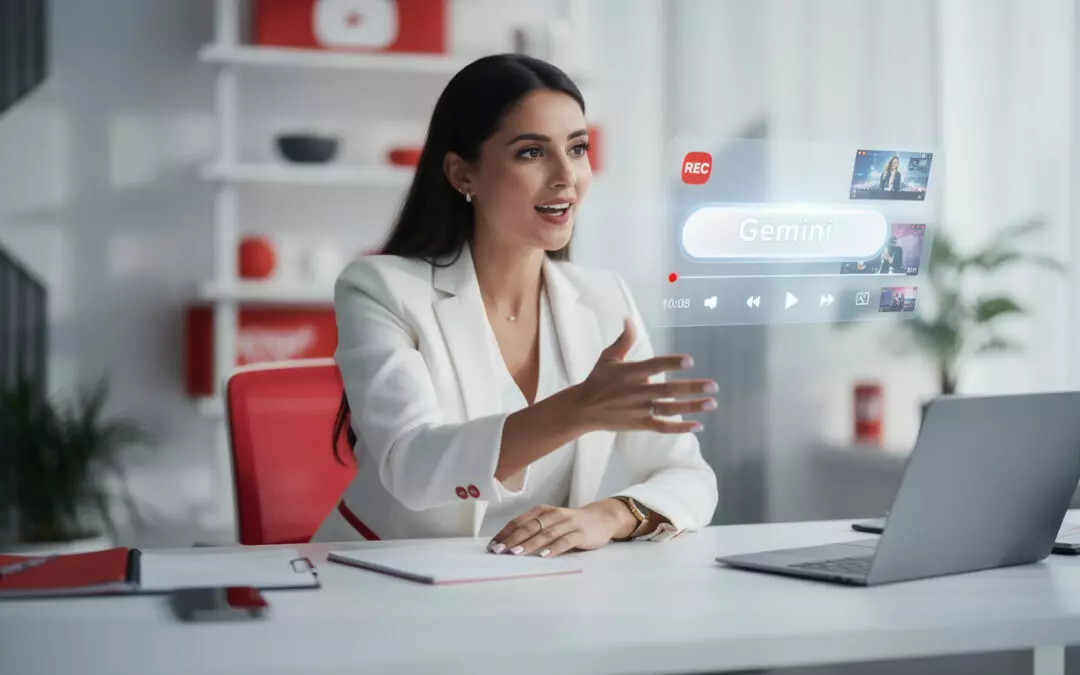
YouTube is testing a Gemini button to transform TV viewing into an interactive experience: live questions, contextualized answers, and guided navigation within the video. Between saving time, new voice uses, and attention-grabbing challenges, this experiment could redefine content consumption.
On smart TVs, consoles, or set-top boxes, the desire to "react" to a video already exists. Now, YouTube is testing a Gemini button which channels this impulse into a concrete tool: querying the content during playback, obtaining an immediate answer and sometimes even restarting the video at the right point.
The interest goes beyond simple curiosity. This function is disrupting search, retention, and the way creators and brands structure their messages, with a direct impact on influence and performance.
YouTube is testing a Gemini button on TVs: how it works, its scope, and user experience.
The principle is simple: during playback, a dedicated button opens a chat interface. After clicking “Ask”, the screen displays a chat module with… suggested questions Ready to use, designed to reduce effort and encourage usage. The experiment primarily targets contexts where typing is cumbersome, particularly on TV.
The scope is intentionally limited: it's not a general-purpose assistant integrated into the entire platform. Here, The answers are limited to the current video.and are anchored in what is shown or explained. A recipe can be "unfolded" into ingredients, an interview can be illuminated by a reminder of context, a technical demonstration can be reformulated into more digestible steps.
On compatible devices, the remote control's microphone becomes a crucial accelerator. A family watching a cooking video can ask, "What are the exact ingredients used in the sauce?" without interrupting the action. Another standout use case is "Restarting the video from the part where he talks about the budget," which transforms AI into navigation tool, not just as a response engine.
This approach complements what already exists on web and mobile, initially in English and a few languages, with a gradual ramp-up. Testing on TVs, consoles and streaming devices serves as a laboratory: remote ergonomics, latency, relevance of responses, and audience tolerance to a conversational layer on top of content.
A common thread helps to understand the appeal: Lina, a fictional lifestyle-oriented creator, publishes a video on her "at-home workout routine." On TV, a viewer asks live, "Which exercise targets the shoulders?" and receives a contextualized answer. The result: the video remains central, and the user doesn't switch to a browser. The viewing becomes a guided sessionThis naturally foreshadows the issues of attention and strategy that will be addressed later.
Impacts for creators, brands and influencers: new reflexes, new KPIs, new risks
When YouTube is testing a Gemini buttonThe impact isn't limited to user comfort. The first change is behavioral: the question that would otherwise go to a search engine remains within the video ecosystem. This "assisted retention" alters the influence funnel: fewer exits, more continuity, therefore potentially more viewing time and better memorization of key messages.
For brands, this encourages the creation of "queryable" videos. A makeup tutorial benefits from clearly stating the products, shades, and steps, as AI relies on this information. A car advertising campaign would be better off verbalizing the features rather than displaying them too quickly on screen. Why? Because the quality of the responses depends on the usable information. Clarity is becoming an algorithmic asset.
A textbook case speaks to social media strategists. A brand launches a collaboration with a tech designer and a promo code is mentioned mid-video. On TV, a user might ask "What's the promo code?" or "When does she mention the price?". If the AI returns a precise timecode, conversion can climb. Conversely, if the video is blurred or the message too implicit, the assistant will respond vaguely, and friction will return.
The major risk is fragmented attention. A chat module encourages users to overconsume information surrounding the video. With emotional content (music, storytelling, documentaries), this layer can disrupt the flow. Creators will have to find a balance: encouraging questions in utilitarian formats while protecting the experience in narrative formats. This is a similar issue to that of "second screens," but internalized within YouTube.
This movement is part of a wider trend: real-time interaction, often via voice, is becoming the norm. Bridges with other interfaces are emerging, notably wearable devices. To remain coherent within the ecosystem, it becomes relevant to observe how uses progress with the smart glasses analysis of the evolution of Ray-Ban Meta and the outlook on Snapchat's augmented reality glasses they show the same logic: reduce the distance between question, context and answerThe final insight is clear: video becomes a conversational entry point, and influence must be written down to be understood, questioned, and replayed.
To gauge real interest, observing usage is just as important as the technology itself. Social media teams can now simulate frequently asked questions and verify whether the video clearly conveys the answer.
Editorial strategy and information design: preparing your videos for the era when YouTube is testing a Gemini button
The best preparation involves treating each video as a miniaturized knowledge base. When YouTube is testing a Gemini buttonCreators benefit from structuring information with easily extractable markers: exact terms, verbal explanations, clear transitions, and useful (without heaviness) repetitions of key elements such as a product name or a method.
A concrete example: a finance channel publishes a video titled “Understanding ETFs.” If the video clearly defines “ETF,” “fees,” and “tracking error,” and illustrates with a comparison, the AI can correctly answer questions during viewing. However, if the video relies on innuendo or unexplained acronyms, the user will receive a response that is difficult to act upon. The goal is not to “speak for the AI,” but to speaking for a questioning spectator.
The TV format also demands precise wording. Questions asked verbally will be short and sometimes imprecise. It's therefore helpful to anticipate natural phrasing: "What's the reference number?", "How much does it cost?", "What's the difference between the two?". High-performing videos will be those that contain answers ready to be rephrased by the assistant, without distortion.
| Objective | Example question via Gemini | Element to include in the video | Expected profit |
|---|---|---|---|
| Accelerate understanding | “Explain this passage simply” | Short definitions + analogies | Fewer books abandon their reading journey |
| Facilitate action | “What ingredients are needed for the recipe?” | Verbalized list + quantities | No longer of immediate use |
| Boost conversion | “What is the promo code?” | Code stated clearly + reminder | Less friction, more buying |
| Improve navigation | “Resume from the point where…” | Time markers and segment announcements | Smoother viewing on TV |
To make this logic operational, a simple test can be conducted before publication: an external observer watches the video and notes the five questions they would ask. If the answers are already in the script, everything is fine. If they require external research, the video lacks "searchable content."
Finally, multi-screen consistency becomes crucial. TV attracts collective attention, while smartphones often serve as a safety net. If a voice assistant helps avoid these back-and-forths, continuity must be reinforced: pinned comments, clear descriptions, and audible prompts. The key idea: A successful video tomorrow will be one that supports conversation..
To delve deeper into these developments and transform them into concrete results, ValueYourNetwork offers a proven methodology. Since 2016, the pilot team hundreds of successful campaigns on social networks, with recognized expertise for connecting influencers and brands and optimize content in response to new uses, such as when YouTube is testing a Gemini buttonTo build a suitable strategy (creation, casting, distribution, measurement), contact us.