
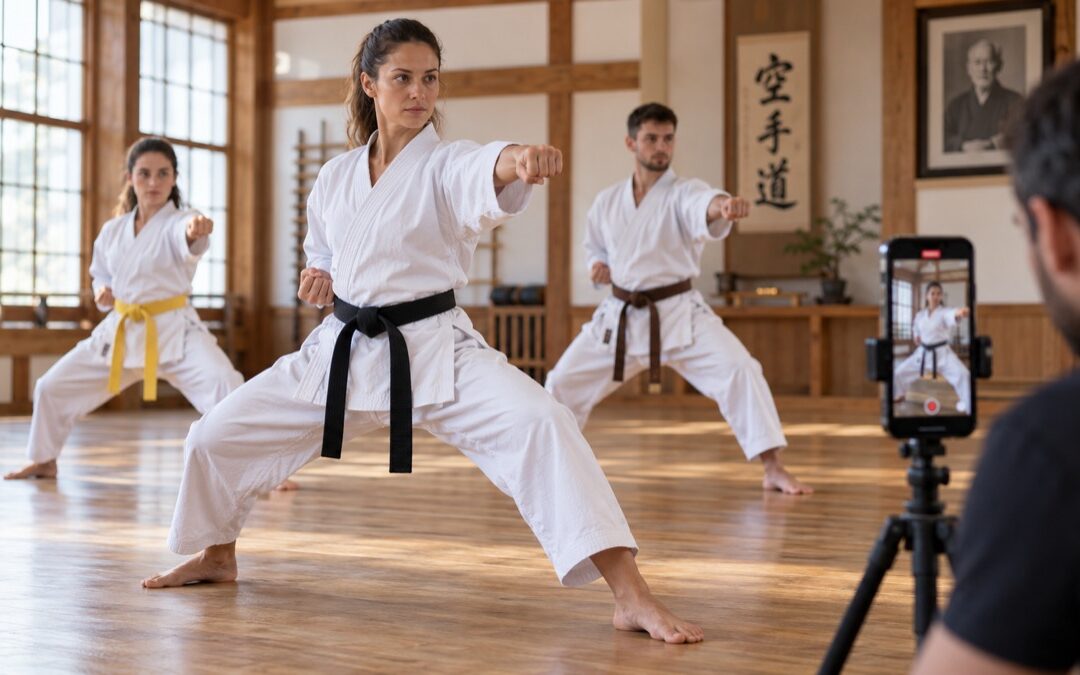
The first lesson in most dojos has nothing to do with punching. You take off your shoes, bow at the door and learn to stand still in a straight line while someone counts in Japanese. It feels strange for about a week. After that it makes sense, because karate is built on the idea that discipline comes before technique. Fans of combat sports and other competitions can follow results on db bet. This guide covers what happens inside the dojo, from the history of the art to the meaning of each coloured belt.
Empty Hand: Where Karate Comes From
Karate is a striking art that uses punches, kicks, knee and elbow strikes and open-hand techniques, combined with blocks and evasive footwork. It developed on Okinawa, an island kingdom with strong trading links to China, where local fighting methods blended with Chinese influences over several centuries. Early Okinawans called it « tōde, » meaning « Chinese hand. » In the 1930s the written characters were changed to « kara-te, » meaning « empty hand, » stressing that it is practised without weapons.
A Member of a Larger Family
Karate belongs to the wider world of Japanese martial arts, often grouped under the word budo, the « martial way »:
- Judo: throws and grappling.
- Aikido: redirecting an attacker’s force.
- Kendo: swordsmanship with bamboo swords.
- Karate: striking.
What unites them is the belief that training should build character as well as fighting ability. Karate is also the youngest of these arts on mainland Japan, reaching Tokyo only in the early twentieth century.
The Teacher Behind the Style
Shotokan karate traces its roots to Gichin Funakoshi, an Okinawan schoolteacher born in 1868. In 1922 he gave a famous demonstration in Tokyo, which led to invitations to teach at Japanese universities. The style’s name comes from his pen name, « Shoto, » meaning « pine waves, » combined with « kan, » meaning « hall. » Funakoshi also wrote twenty guiding principles, the Niju Kun. The most famous says there is no first attack in karate.
From Tokyo to the World
After Funakoshi died in 1957, his senior students carried the work forward. The Japan Karate Association, founded in 1949, standardised training and sent instructors abroad, and through the 1960s and 1970s they opened dojos across Europe, the Americas, Africa and Asia. Today Shotokan is often described as the most widely practised karate style in the world.
The Three Pillars of Training
Kihon
Basics: stances, punches, kicks and blocks, repeated until they are precise and powerful. Beginners often find this the hardest part, because repetition demands patience.
Kata
Prearranged sequences performed against imaginary opponents. Students usually begin with the five Heian kata before moving on to advanced forms such as Bassai Dai, Kanku Dai, Jion and Empi.
Kumite
Sparring, from tightly controlled drills with agreed attacks and defences to free sparring against a resisting partner.
Dojo Etiquette in Brief
- Bow when entering and leaving the training area.
- Address the instructor as sensei.
- Keep your gi clean and your nails short.
- Remove jewellery before class.
- Listen first, ask questions once an exercise is finished.
What Makes Shotokan Look Different
Shotokan is known for long, low stances that build leg strength and stability. Techniques are linear and fully committed, generating power through alignment and hip rotation. Critics call very deep stances impractical; supporters say they build the foundation for controlled power.
The Karate Belt Order
The karate belt order gives students a clear path from beginner to advanced. The system was introduced in judo by Jigoro Kano, and Funakoshi adopted it in the 1920s. Kyu grades for students count down to first kyu, and dan grades for black belts count up from first dan. Colours vary between organisations, but a common Shotokan progression looks like this:
| Belt | Typical grade | What students usually focus on |
| White | 9th or 10th kyu | Basic stances, etiquette, first punches and blocks |
| Yellow | 8th kyu | Combining techniques, first Heian kata |
| Orange | 7th kyu | Smoother movement and stronger stances |
| Green | 6th kyu | More kata, controlled sparring drills |
| Blue | 5th kyu | Timing and distance in kumite |
| Purple | 4th kyu | Refining kata and power generation |
| Brown | 3rd to 1st kyu | Advanced kata, preparation for black belt |
| Black | 1st dan and above | The start of deeper study and teaching |
Black Belt Is a Beginning
The first black belt, shodan, is not mastery. It marks the point where a student knows the fundamentals well enough to begin serious study.
How a Grading Works
- Kihon: the examiner calls techniques and combinations.
- Kata: each student performs the forms required for their level.
- Kumite: sparring appropriate to the rank.
- Feedback: examiners announce results and explain what to improve.
Examiners look for technique, spirit and understanding, not speed alone, and waiting times grow at higher levels. Many adults balance dojo life with other hobbies, and readers in Uzbekistan who enjoy an occasional game online between classes can find a local platform at kazino uz, as long as it stays a moderate, responsible pastime.
Other Styles and the Olympic Stage
Goju-ryu blends hard and soft techniques with breathing exercises, Shito-ryu keeps a large catalogue of kata, Wado-ryu adds evasive movement influenced by jujutsu, and Kyokushin is famous for full-contact sparring. Karate made its Olympic debut at the Tokyo 2020 Games, held in 2021, with medals in kata and kumite. It was not included in Paris 2024 and is not part of the Los Angeles 2028 programme.
Kung Fu vs Karate
The kung fu vs karate comparison starts with origins. Kung fu is a broad term for Chinese martial arts with hundreds of styles, from Shaolin systems to tai chi. Karate developed later and more narrowly on Okinawa, which is why some kata still show Chinese influence. Shotokan favours direct, linear techniques and decisive single strikes, while many kung fu styles prefer circular, flowing motion, sometimes imitating animals such as the tiger or crane. Karate also follows standard belt grades and exams, whereas kung fu varies far more from school to school.
Choosing Your Path
If you like clear structure and measurable progress, Shotokan is a rewarding choice. If you are drawn to fluid movement and cultural variety, kung fu may suit you better. Either way, the instructor and the atmosphere of the school matter more than the name on the door.