
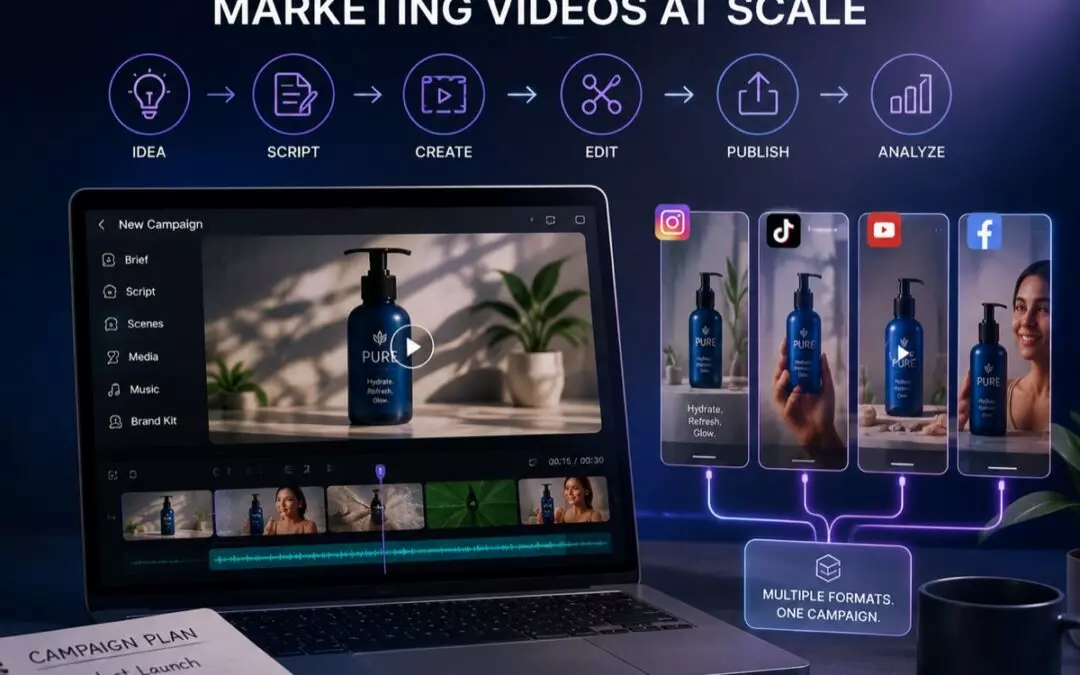
Marketing teams today need more video content than ever before. Brands are expected to create advertisements, social media videos, product explainers, customer stories, tutorials, and campaign assets across multiple platforms.
The challenge is not creating one good video. The challenge is producing enough high-quality videos consistently while maintaining brand identity, messaging, and creative quality.
Traditional video production often requires multiple teams, long timelines, and significant resources. For businesses running frequent campaigns, this makes it difficult to keep up with the demand for fresh content.
AI video tools are changing this process by helping marketing teams move from an initial idea to a complete video asset faster. Instead of handling scripting, visuals, editing, and publishing as separate tasks, modern AI workflows connect different stages of production into a more efficient process.
The best AI tools for marketing videos do more than generate clips. They help teams plan campaigns, create variations, adapt content for different channels, and produce videos at the speed required by modern marketing.
Here are some of the best AI tools helping businesses create marketing videos at scale.
1. Invideo Agent
Invideo Agent is an AI video creation platform designed for complete marketing workflows, helping teams turn ideas, briefs, and campaign concepts into finished videos. Rather than focusing only on generating individual scenes, it supports the full creative journey, including planning, scripting, visual development, generation, editing, and refinement.
For marketing teams, this approach is valuable because campaigns rarely require a single video. A product launch, seasonal promotion, or brand campaign may need multiple versions for social media, paid ads, landing pages, email campaigns, and different customer segments.
Invideo Agent helps teams build these assets while keeping the campaign direction connected. Creative decisions around messaging, visual style, product presentation, and storytelling can remain aligned across different videos.
Key Features:
- Converts marketing ideas and briefs into complete video concepts
- Supports campaign videos, ads, explainers, and social content
- Helps maintain visual and messaging consistency
- Creates videos for different formats and platforms
- Connects ideation, production, editing, and optimization workflows
Best For:
- Marketing teams producing content regularly
- Brands scaling video advertising campaigns
- Businesses creating multi-platform video assets
- Teams looking for a connected AI video workflow
For larger campaigns involving multiple assets and collaborators, invideo Agent Two adds a more advanced layer of creative coordination. It helps teams manage complex projects by keeping important creative decisions connected across areas such as visual direction, story planning, cinematography, and post-production. This makes it useful when brands need consistency across many videos rather than just a single creative output.
2. Runway
Runway is an AI video creation platform focused on generative video, creative editing, and visual storytelling. It is widely used by creative teams that want to develop unique visuals and experiment with new forms of video production.
For marketing teams, Runway can help create attention-grabbing campaign visuals, branded storytelling pieces, and creative concepts that may be difficult or expensive to produce traditionally.
Its generative capabilities allow marketers to explore different visual directions quickly, making it useful during the creative development stage of campaigns.
Key Features:
- AI video generation
- Generative editing tools
- Visual effects creation
- Image-to-video workflows
- Creative scene generation
Best For:
- Brand storytelling campaigns
- Creative marketing teams
- Visual concept development
- Premium advertising content
Where It Falls Short:
Runway is strong for creative exploration but may require additional tools or workflows for managing large-scale marketing campaigns with many connected assets.
3. HeyGen
HeyGen is an AI video platform focused on creating videos with digital presenters and AI avatars. It helps businesses create presenter-led content without requiring traditional filming setups.
For marketing teams, HeyGen can be useful for creating product explainers, educational videos, social media content, and localized marketing campaigns. Brands can use consistent AI presenters across different videos while adapting scripts for different audiences.
This makes it particularly useful for businesses that need recurring spokesperson-style content.
Key Features:
- AI avatar presenters
- Voice generation
- Multilingual video creation
- Script-based video production
- Presenter customization
Best For:
- Product education videos
- Global marketing campaigns
- Training and communication content
- Presenter-led advertisements
Where It Falls Short:
HeyGen works best for presenter-based videos. Brands looking for cinematic storytelling, complex visual campaigns, or highly customized scenes may need additional creative tools.
4. Canva AI Video Tools
Canva is a widely used design platform that includes AI-powered features for creating marketing visuals and videos. It is popular among businesses that need simple, branded content without complex editing workflows.
For marketing teams, Canva can help create social media videos, promotional graphics, presentations, and campaign assets while maintaining brand templates and visual identity.
Its biggest advantage is accessibility, allowing teams to quickly produce content without requiring advanced design skills.
Key Features:
- AI-assisted video creation
- Marketing templates
- Brand kits
- Social media formats
- Graphic and video editing tools
Best For:
- Small marketing teams
- Social media content creation
- Quick campaign assets
- Brand-focused videos
Where It Falls Short:
Canva is excellent for design-driven marketing content but is less focused on advanced video storytelling, AI filmmaking workflows, or complex multi-scene production.
5. Synthesia
Synthesia is an AI video platform that creates videos using digital presenters. It is widely used for business communication, training, and educational content, but it can also support marketing teams that need consistent presenter-based videos.
Brands can use Synthesia to create product walkthroughs, customer education content, and internal marketing videos without organizing traditional shoots.
Its structured approach makes it useful for repeatable video production.
Key Features:
- AI presenters
- Text-to-video creation
- Voice options
- Multilingual support
- Professional video templates
Best For:
- SaaS marketing videos
- Educational content
- Product tutorials
- Business communication
Where It Falls Short:
Synthesia is designed mainly around structured presenter videos. It may not be the best choice for brands creating highly creative campaigns, UGC-style ads, or cinematic marketing content.
6. Pictory
Pictory is an AI video creation platform focused on transforming scripts, articles, and existing content into videos. It is commonly used by marketers who want to repurpose written content into engaging video formats.
For marketing teams, Pictory can help convert blogs, webinars, and long-form content into shorter videos for social media and campaigns.
This makes it useful for businesses that already have large amounts of written content.
Key Features:
- Script-to-video creation
- Content repurposing
- Automatic captions
- Video summaries
- Social media formats
Best For:
- Content marketing teams
- Blog-to-video workflows
- Educational videos
- Social media repurposing
Where It Falls Short:
Pictory is more focused on content conversion than complete creative campaign production. Teams creating original visual stories or highly customized advertisements may need other solutions.
How AI Tools Help Marketing Teams Scale Video Production
Creating videos at scale requires more than faster generation. Marketing teams need systems that help them maintain quality while increasing output.
AI tools support this by reducing repetitive tasks and helping teams create more content from the same campaign idea.
A single concept can become:
- Social media videos
- Paid advertisements
- Product explainers
- Email campaign videos
- Website content
- Customer education assets
This allows marketers to maximize the value of every creative idea.
Why Complete Video Workflows Matter for Marketing
Marketing videos involve multiple stages, from brainstorming and scripting to editing and publishing.
When these stages are disconnected, teams often spend time moving files, rewriting instructions, and recreating creative decisions.
A connected workflow helps teams move faster because campaign context remains available throughout production.
This is especially important for brands creating large volumes of content where consistency matters.
Creating More Video Variations for Campaign Testing
Modern marketing depends heavily on experimentation.
Brands often test different:
- Opening hooks
- Messages
- Visual styles
- Audiences
- Calls to action
AI video workflows make it easier to produce these variations without rebuilding every campaign asset manually.
This helps marketers discover which creative approaches perform best while reducing production effort.
Maintaining Brand Consistency Across Multiple Videos
Producing more videos should not mean losing brand identity.
Successful marketing campaigns require consistency in:
- Visual style
- Product presentation
- Messaging
- Tone
- Overall creative direction
AI tools that support connected workflows help teams maintain these elements across multiple videos and platforms.
How to Choose the Right AI Marketing Video Tool
The right tool depends on the type of marketing content a business needs.
Brands creating social content may prioritize speed and templates, while teams producing larger campaigns may need stronger planning and workflow capabilities.
Important factors to consider include:
- Type of videos needed
- Number of assets required
- Platform requirements
- Brand consistency needs
- Collaboration features
- Editing flexibility
For teams producing content regularly, tools that support complete workflows can provide more value than tools focused only on generating individual clips.
Final Thoughts
AI video tools are changing how marketing teams create and distribute content. Instead of treating video production as a slow, resource-heavy process, businesses can now build workflows that support faster ideation, creation, editing, and publishing.
The biggest advantage comes from using AI not just as a generation tool, but as part of a complete creative system.
For brands creating videos at scale, the future of marketing will depend on workflows that combine automation with strong creative direction, allowing teams to produce more personalized and engaging content without sacrificing quality.