
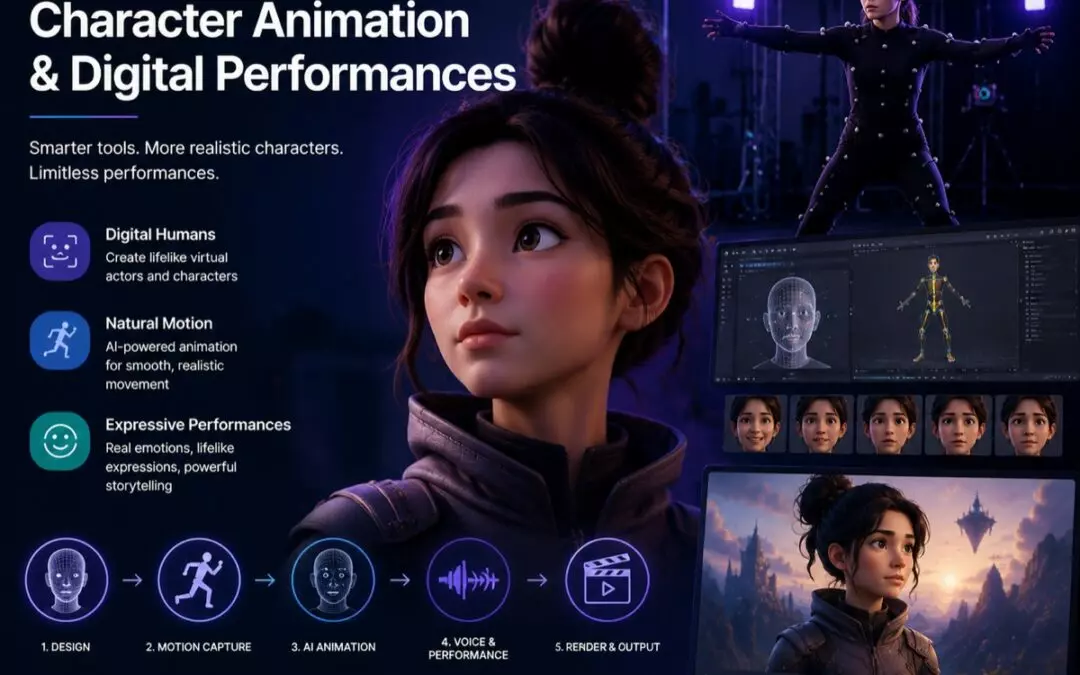
Creating believable digital characters has always been one of the most challenging parts of animation and visual storytelling. A character is not defined only by appearance. The way it moves, reacts, expresses emotions, and interacts with its environment determines whether audiences connect with it.
For decades, animators have manually created movements frame by frame, while filmmakers have relied on motion capture, voice actors, and visual effects teams to bring digital characters to life. These methods continue to play an important role, but AI is introducing new possibilities for creating and controlling digital performances.
Today, AI is helping creators design characters, generate animations, improve facial expressions, create virtual actors, and build more realistic performances with fewer production barriers. Instead of replacing traditional animation techniques, AI is becoming another creative layer that helps artists explore ideas faster and develop more detailed digital worlds.
Why Character Animation Is Challenging
Animating a character involves much more than making it move.
A convincing digital performance requires several elements to work together:
- Natural body movement
- Facial expressions
- Emotional reactions
- Voice delivery
- Character personality
- Interaction with the environment
A character walking across a scene is easy to create. Making that character look nervous, excited, confident, or emotional requires a deeper understanding of human behavior.
This is why character animation often requires teams of artists, animators, performers, and technical specialists working together.
AI is changing this process by helping creators handle some of these complex tasks more efficiently while giving them more room to focus on storytelling.
AI Is Making Character Creation More Flexible
The first stage of creating a digital performance is developing the character itself.
AI tools can help creators explore different character designs, appearances, styles, and visual identities before production begins. Instead of spending significant time creating early concepts manually, artists can quickly experiment with different directions.
For example, a filmmaker developing a fantasy character may explore different:
- Facial features
- Clothing styles
- Ages
- Visual personalities
- Character environments
This allows creative teams to refine their vision before moving into animation.
However, creating a strong digital character requires more than generating a single image. The character needs to remain recognizable across different scenes, expressions, and performances.
Maintaining Character Identity Across Performances
One of the biggest challenges in AI-generated characters is consistency.
A character that looks different in every scene can make the story feel disconnected. This becomes especially important for digital actors, animated series, and long-form storytelling where the same character appears repeatedly.
Creators need to maintain consistency in:
- Facial structure
- Hairstyle
- Clothing
- Body proportions
- Movement style
- Emotional expressions
AI workflows are becoming better at preserving these details by allowing creators to work with references, creative direction, and connected production environments.
This makes it easier to develop characters that feel like they have a continuous identity rather than appearing as separate generations.
How AI Is Improving Digital Performances
Digital performances combine multiple creative elements, including movement, voice, expressions, and storytelling.
AI is helping improve each of these areas.
More Natural Character Movement
Movement is one of the most important parts of believable animation. AI can analyze human motion, understand body mechanics, and help generate more natural actions.
This is useful for:
- Animated characters
- Virtual influencers
- Digital actors
- Game characters
- AI-generated films
Instead of manually creating every movement, creators can use AI-assisted workflows to develop more realistic performances.
Better Facial Expressions
Facial expressions communicate emotion more effectively than dialogue alone.
AI-powered facial animation can help characters display:
- Smiles
- Reactions
- Eye movement
- Emotional changes
- Subtle expressions
These details help digital characters feel more alive and improve audience connection.
Improved Voice and Performance Matching
A character’s voice needs to match its personality and appearance.
AI voice technology helps create more consistent character voices while allowing creators to experiment with different tones, languages, and performance styles.
When voice, facial movement, and body language work together, digital characters become much more convincing.
Virtual Actors Are Changing Content Creation
Virtual actors are becoming increasingly common in entertainment, advertising, and digital media.
Unlike traditional actors, virtual characters can be designed for specific roles, reused across campaigns, and adapted for different types of content.
Brands can use virtual actors for:
- Product advertisements
- Social media campaigns
- Brand storytelling
- Digital experiences
- Interactive content
The advantage is not only reducing production limitations. Virtual actors also allow creators to build unique personalities that exist entirely within digital environments.
However, creating successful virtual actors requires consistency. Audiences need to recognize the same character across different appearances, just like they would with a real performer.
AI Agents Are Creating New Character-Based Workflows
Character-driven projects involve many moving parts. A filmmaker may need to manage character design, animation style, scene direction, camera choices, voice, and visual effects at the same time.
AI-assisted workflows are helping bring these creative decisions together.
Invideo Agent supports character-focused video creation by helping creators move from early concepts to complete video projects. It can assist with developing scenes, shaping visual direction, generating content, and refining videos while keeping the creative process connected.
This approach is useful for projects where characters need to remain consistent while appearing across multiple scenes, formats, or campaigns.
For more complex productions, invideo Agent Two expands this approach by helping creative teams coordinate different aspects of production through a more collaborative workflow. It can support creative roles such as cinematography, story development, visual planning, and effects, helping teams maintain a shared understanding of the character, world, and overall performance direction throughout a project.
AI and Animation Production Workflows
Traditional animation often involves several stages, including:
- Concept development
- Character design
- Storyboarding
- Rigging
- Animation
- Rendering
- Editing
AI is influencing many of these stages by reducing repetitive tasks and helping creators move faster.
For example, AI can assist with:
- Generating early character concepts
- Creating animation references
- Improving movement
- Enhancing visual effects
- Supporting editing workflows
This allows artists to spend more time making creative decisions instead of managing repetitive production tasks.
The Role of Motion Capture in AI Character Animation
Motion capture has been an important technology in digital performances for years. It allows real human movement to be recorded and transferred to digital characters.
AI is making motion capture more accessible by improving how movement data is captured, analyzed, and applied.
This combination helps creators produce:
- More realistic character animation
- Better action sequences
- Natural body movement
- Expressive digital performances
For virtual actors and AI-generated characters, motion capture provides the human performance layer that makes digital characters feel more believable.
Challenges of AI-Generated Digital Performances
While AI is improving character animation, challenges still remain.
Maintaining Emotional Depth
Generating movement is easier than creating genuine emotional performances. Human creativity is still essential for deciding how a character should feel and react.
Character Consistency
Long-form projects require strong control over character identity across many scenes.
Creative Direction
AI can provide possibilities, but filmmakers and artists still need to guide the story, style, and performance.
Balancing Automation and Artistry
The best results come from combining AI capabilities with human creative decisions rather than relying only on automation.
The Future of AI Characters and Digital Humans
AI is moving character animation beyond simple visual generation. The future is focused on creating digital characters that can perform, express emotions, and exist within larger stories.
As AI tools become more advanced, filmmakers, animators, and brands will have more ways to create virtual actors and immersive experiences.
The next generation of digital performances will likely combine AI animation, voice technology, motion capture, and intelligent creative workflows to produce characters that feel more realistic and engaging.
Final Thoughts
AI is transforming character animation by making digital performances more accessible, flexible, and detailed. From virtual actors and animated characters to branded digital personalities, creators now have new ways to bring ideas to life.
However, the strongest digital characters will always come from a combination of technology and storytelling. AI can help create movement, expressions, and visuals, but human creativity remains the foundation behind memorable characters.
As AI continues to evolve, character animation will become less about building individual frames and more about creating complete digital performances with personality, emotion, and continuity.